Should a Man Get a DEXA Scan? What the Guidelines Actually Say
Disclosure: We may earn a commission if you purchase through links on this page. This does not affect our editorial assessment. See our affiliate disclosure.
Your wife has had a bone density scan. Your sister has had two. You have had the blood pressure cuff, the cholesterol panel, the colonoscopy and a long conversation about your prostate, and nobody has once mentioned your bones. That is not your doctor being careless. It is a real gap in the guidelines, and it helps to know what that gap looks like before you walk in and ask.
Men do break bones from thin bone, and when they do the consequences tend to be serious. That part is not in dispute, and our fuller piece on osteoporosis in men over 50 covers the background. What is in dispute is who gets tested, at what age, and on whose say-so.
The guidelines for men genuinely do not agree
Start with the body most American primary care doctors take their cues from. In its January 2025 recommendation, the US Preventive Services Task Force concluded that the current evidence is insufficient to assess the balance of benefits and harms of screening for osteoporosis in men. That grade I statement is not a recommendation against scanning men; it is the Task Force saying the research has not been done well enough to say either way. For women 65 and over, the same document gives a clear grade B recommendation to screen. Two people of the same age in the same waiting room, and only one has a guideline pointing at her.
Specialist bodies have been less hesitant. The Endocrine Society’s clinical practice guideline on osteoporosis in men recommends testing bone density in men aged 70 and over, and in men aged 50 to 69 who have risk factors. Seventy is the number you will see most often, with the door left open for testing earlier when the history warrants it.
Then there is what your insurance will pay for. Medicare Part B covers a bone mass measurement once every 24 months, or more often if medically necessary, but coverage runs on qualifying conditions rather than age: X-rays suggesting osteoporosis, osteopenia or vertebral fracture; taking or planning to start prednisone or other steroid-type drugs; primary hyperparathyroidism; monitoring of osteoporosis drug therapy. Notice what is missing. Simply being a 72-year-old man is not, by itself, a ticket to a covered scan. If you do meet one of those conditions, say so plainly when you ask.
So a specialist would probably scan you at 70, a general screening body says the evidence is not there yet, and the payer wants a reason from a list. Those answers do not reconcile, and pretending otherwise does you no favors.
The risk factors that should get you scanned much earlier
Age is the weakest part of the argument for men. Your history is the strong part. If any of the following apply, the case for a scan does not wait until 70, and most doctors will agree once you name it.
- Long-term oral steroids such as prednisone, for asthma, polymyalgia rheumatica, inflammatory bowel disease or anything else — one of the clearest triggers there is, and we explain why in our piece on corticosteroids and bone loss.
- Androgen deprivation therapy for prostate cancer, which lowers testosterone deliberately and takes bone density with it.
- Any fracture after 50 from a fall at standing height or less — a wrist on an icy sidewalk, a rib against a doorframe. That is a fragility fracture, and it is information.
- Measurable height loss, or a stoop that has crept in over a few years.
- Low testosterone or hypogonadism from any cause.
- Coeliac disease or another condition that impairs absorption, hyperthyroidism, chronic kidney or liver disease.
- Heavy alcohol use, smoking, or a body weight that has always been light.
- Years on a proton pump inhibitor, or long-term use of certain anti-seizure medications.
None of these means you have thin bone. They shift the odds enough that guessing stops being reasonable, which is exactly what a scan is for. Bone loss causes no symptoms until something breaks, so there is nothing to feel and nothing to wait for.
What the scan is actually like
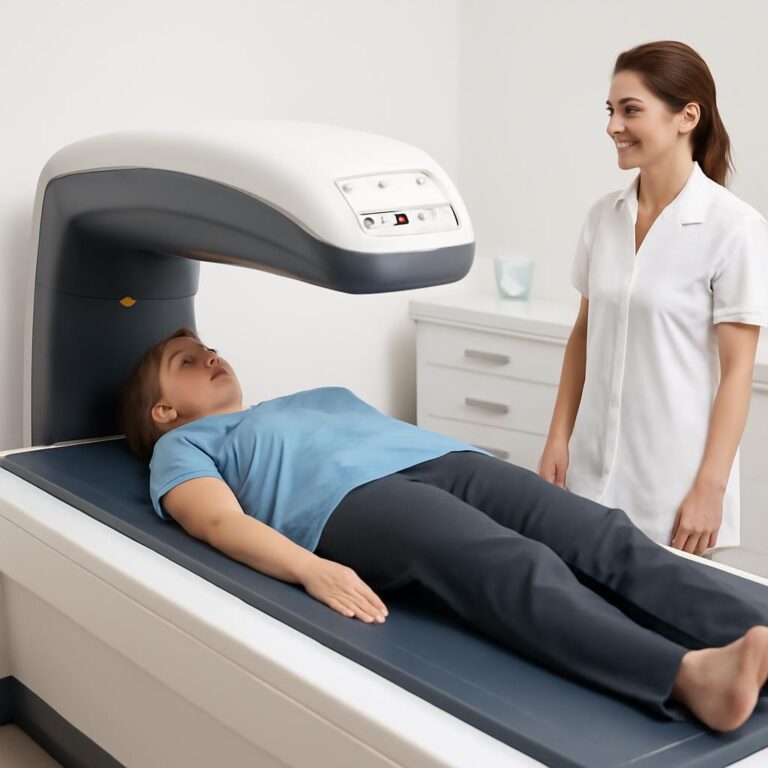
Men sometimes brace for this one, and there is nothing to brace for. A DEXA scan means lying flat and fully clothed on a padded table while a scanning arm passes over your hip and lower spine. Nothing touches you, nothing hurts, and it takes a few minutes. The radiation dose is very low, well below a standard chest X-ray. Leave belts and metal zippers at home, and that is the extent of the preparation.
If you are paying out of pocket, a DEXA typically runs somewhere around $75 to $250 in the US, approximate and at the time of writing; our guide to DEXA scan cost and where to get one covers how to bring that down.
Reading the result, and the reference-database problem for men
Your report comes back with a T-score, comparing your bone density to a healthy young adult, and a Z-score, comparing you to others your own age and sex. Down to -1.0 is normal, -1.0 to -2.5 is the range usually labeled osteopenia, and -2.5 or below meets the density definition of osteoporosis. Our walkthroughs on how to read DEXA scan results and T-score versus Z-score unpack the numbers properly.
Here is the part almost nobody tells men, and it is worth raising with your doctor. That “healthy young adult” your T-score is measured against may not be a man. The International Society for Clinical Densitometry’s official positions call for a uniform white female reference for men of all ethnic groups, and the International Osteoporosis Foundation has taken the same approach with a single reference standard for both sexes. The Endocrine Society’s guideline on osteoporosis in men, by contrast, has recommended a young male reference range. Two respected bodies, pointing in opposite directions.
The consequence is not academic. Young men have higher peak bone density than young women, so the same scan read against a male database generally produces a lower, worse-looking T-score than against a female one. There are men sitting right around the -2.5 line who would be labeled osteoporotic under one convention and osteopenic under the other, with no change in their actual bones. This has been argued over for years and is not settled. You do not have to referee it, but do ask which database your center used, and make sure any treatment decision rests on your whole picture rather than one number that could have gone either way.
What FRAX adds, and how often to repeat
A T-score describes your bone. FRAX tries to describe your risk, which is a different and often more useful thing. It is a short questionnaire — age, weight and height, prior fracture, parental hip fracture, smoking, steroids, rheumatoid arthritis, alcohol — estimating your probability of a major fracture over the next ten years, with or without a hip bone density value added in. For men it pulls the picture into focus, because a middling T-score alongside steroid use and a previously broken wrist adds up to more than the score alone suggests. Our FRAX score calculator explainer shows how to read the output.
On repeating the scan, there is no single correct interval. Bone changes slowly, and a repeat done too soon mostly measures the machine’s own margin of error. Around two years is a common rhythm, longer if your first result was reassuring, sooner if you have started steroids or hormone therapy or begun treatment someone needs to monitor — we go through it in how often to have a DEXA scan after 50. Go back to the same machine where you can, since comparing across different equipment adds error you cannot see.
How to ask, and what to say if you get pushback
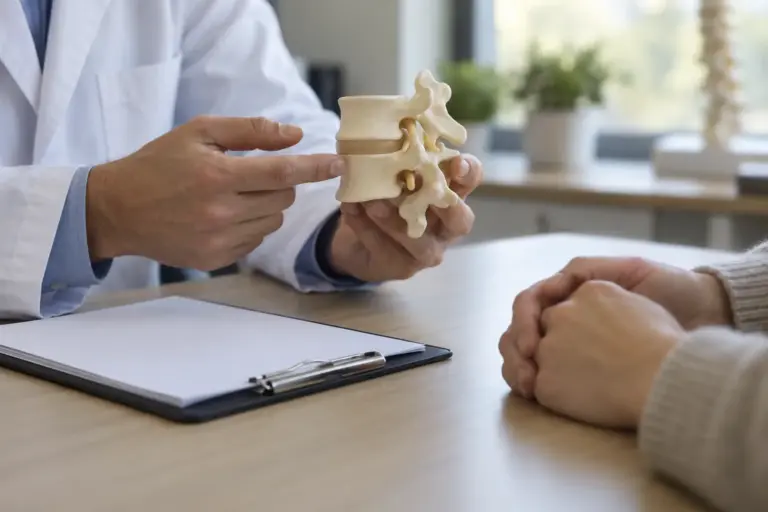
Asking for “a bone scan because I read something” tends to go nowhere. Asking with a reason works far better. Lead with your risk factors rather than your age: three years on prednisone, hormone therapy for prostate cancer, a wrist broken at 58, an inch of height gone. Then ask the direct question — given this history, is a DEXA scan reasonable for me now?
If the answer is no, that may be a defensible clinical judgment, and it is fair to ask what it rests on. A useful follow-up is whether your doctor would run a FRAX assessment first, since it costs nothing and can itself justify the scan. It helps to say you understand the general screening evidence in men is graded insufficient, and that you are asking because of your own risk factors rather than a blanket recommendation. If that goes nowhere and your risk factors are real, a second opinion or a referral to an endocrinologist is a legitimate next step.
What you can do either way, while you wait
Whether the scan happens next month or not at all, the things that protect a man’s skeleton are the same, and none of them require a result first. Progressive resistance training is the strongest lever you have, because bone responds to load. Adequate protein, enough calcium and vitamin D, less alcohol, no smoking and better balance all pull the same way. Our guide on how to improve bone health after 50 puts the practical pieces together.
If you would rather follow a structured plan than assemble one yourself, The Bone Density Solution packages the diet and exercise side into a program built for adults over 50, and our full review covers what it does and does not include. Treat it as support alongside your doctor’s care, never as a substitute for the scan or for treatment if you need it.
The short version: if you are a man over 70, or over 50 with any of the risk factors above, asking for a DEXA scan is a sensible thing to do. The guidelines disagreeing with each other is a reason to have the conversation, not to skip it.
The Bone Density Solution
A structured program designed for adults over 50 to support bone density through diet, exercise, and lifestyle changes — an integrated approach to reducing fracture risk. Best used alongside, not instead of, professional medical care.
Check The Bone Density Solution →Affiliate link — we may earn a commission at no extra cost to you. Full disclosure.
Sources
- US Preventive Services Task Force — osteoporosis screening recommendation, including the grade I statement for men
- Medicare.gov — bone mass measurement coverage, frequency and qualifying conditions
- International Society for Clinical Densitometry — official adult positions on reference databases and T-score reporting
- Endocrine Society — clinical practice guideline on osteoporosis in men, including testing age and reference range
- International Osteoporosis Foundation — diagnosis, BMD measurement and diagnostic thresholds
- NIAMS (US National Institutes of Health) — osteoporosis overview and risk factors
Medical disclaimer: This article is for informational purposes only and is not medical advice. See our full medical disclaimer.