How to Read Your DEXA Scan Results: T-Scores, Z-Scores, and What They Mean
Disclosure: We may earn a commission if you purchase through links on this page. This does not affect our editorial assessment. See our affiliate disclosure.
You’ve just had a DEXA scan — the gold-standard test for measuring bone density. The results are in your hand. There are numbers on the page, some letters you don’t recognize, and possibly a word like “osteopenia” or “osteoporosis” that’s making you anxious. This guide will walk you through exactly what everything means, in plain language.

What a DEXA Scan Measures
A DEXA (dual-energy X-ray absorptiometry) scan uses two low-level X-ray beams to measure how dense your bones are — specifically, how much mineral content is packed into a given area of bone. It’s quick, painless, and uses very little radiation (less than a transatlantic flight).
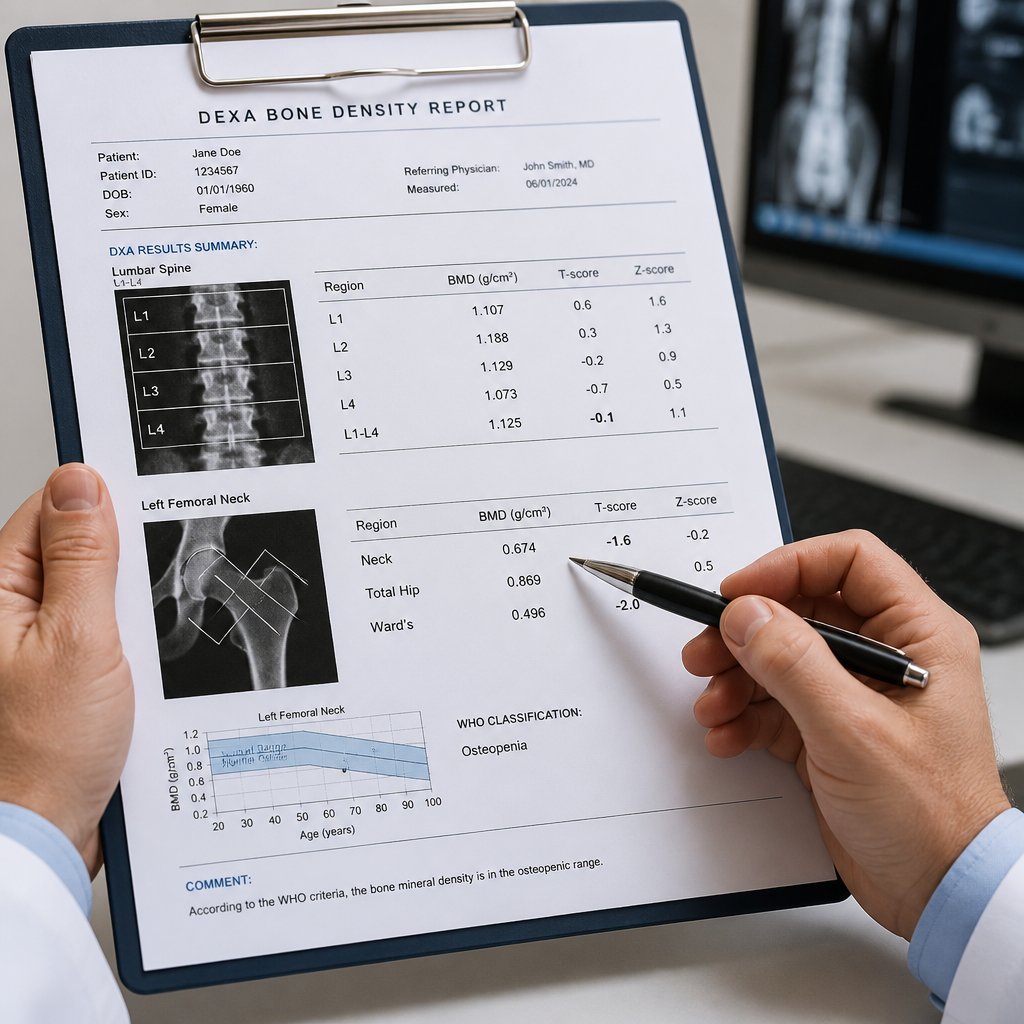
Results are typically reported for two sites: the lumbar spine (lower back) and the hip (usually the femoral neck and total hip). Sometimes the forearm (distal radius) is measured as well, particularly if the hip or spine can’t be measured accurately.
Understanding Your T-Score
The T-score is the number most people focus on — and for good reason. It compares your bone density to the average peak bone density of a healthy young adult (typically a 30-year-old of the same sex).
| T-Score | Classification | What it means |
|---|---|---|
| -1.0 or above | Normal | Bone density is within the healthy range |
| Between -1.0 and -2.5 | Osteopenia | Below average; not yet osteoporosis, but worth attention |
| -2.5 or below | Osteoporosis | Significantly low bone density; fracture risk is elevated |
| -2.5 or below + fragility fracture | Severe osteoporosis | High fracture risk requiring active management |
These thresholds are established by the World Health Organization and are the standard used by doctors worldwide. A T-score of -1.5, for example, means your bone density is 1.5 standard deviations below the young adult average — not a crisis, but a clear signal to take bone health seriously.
Understanding Your Z-Score
The Z-score compares your bone density to the average for someone of your same age, sex, and sometimes ethnicity. Rather than comparing you to peak bone mass, it asks: how do you compare to your peers?
A Z-score of -2.0 or below is considered “below the expected range for age” and may indicate that bone loss is occurring faster than normal for your age — which could point to an underlying secondary cause worth investigating (such as vitamin D deficiency, celiac disease, or medication effects).
For postmenopausal women and men over 50, the T-score is the primary diagnostic tool. The Z-score is more commonly used for premenopausal women, men under 50, and children, where comparing to age-matched peers is more meaningful.
Site-by-Site: Spine vs. Hip
Your report will give separate scores for the spine and hip — and they may differ. It’s not unusual to have osteopenia at one site and normal density at another, or even osteoporosis at the spine with osteopenia at the hip.
The spine tends to show changes earlier, because it contains more trabecular (spongy) bone, which responds more quickly to hormonal changes. The hip — particularly the femoral neck — is the site most strongly associated with serious fracture risk. Hip fractures in older adults carry significant health consequences, which is why hip measurements are taken very seriously in clinical decisions.
FRAX Score: The Bigger Picture
Your DEXA T-score alone doesn’t tell the whole story of your fracture risk. Many doctors now also use the FRAX tool (Fracture Risk Assessment Tool), developed by the World Health Organization, which combines bone density with other clinical risk factors to estimate your 10-year probability of a major osteoporotic fracture.
FRAX takes into account: your age, sex, body weight, previous fracture history, family history of hip fracture, smoking, alcohol use, use of corticosteroids, rheumatoid arthritis, and secondary causes of osteoporosis — in addition to your femoral neck T-score.
Two people with the same T-score can have very different FRAX scores depending on their other risk factors. This is why clinical decisions about treatment aren’t based on T-score alone.
What “Osteopenia” Really Means
Many people receive an osteopenia diagnosis and feel alarmed — as if they’re partway to a serious disease. It’s worth reframing this. Osteopenia simply means your bone density is lower than the statistical average for young adults, but it does not automatically mean you will develop osteoporosis, and it certainly doesn’t mean a fracture is imminent.
Osteopenia is best understood as a signal: your bone health deserves attention, and now is a good time to make changes. For many people, targeted nutrition, exercise, and appropriate supplementation can stabilize or even improve bone density from an osteopenic baseline.
Questions to Ask Your Doctor
When you review your DEXA results with your doctor, consider asking:
- What are my T-scores at each site, and what do they mean for my fracture risk?
- Can we calculate my FRAX score?
- Is there anything in my history that might be contributing to bone loss beyond normal aging?
- Should I have my vitamin D levels tested?
- When should I repeat the DEXA scan?
- What changes in diet, exercise, or supplementation would you recommend?
- At what point would you consider medication?
What to Do After Getting Your Results
Whatever your results, the most important response is an active one — not anxiety, but a clear plan.
If your results are normal: This is excellent news, but not a reason for complacency. Bone density peaks around age 35 and declines from there. Continue the lifestyle habits — weight-bearing exercise, adequate calcium and vitamin D, balanced nutrition — that support healthy bones.
If you have osteopenia: This is your window to act before the situation progresses. If you have osteopenia, lifestyle changes may help reduce some risk factors and support bone health over time, but the right approach depends on your fracture risk, medical history and your doctor’s recommendations. Talk to your doctor about calcium and vitamin D targets, consider adding resistance training to your exercise routine, and discuss whether supplementation with vitamin K2 or magnesium might be appropriate for you.
If you have osteoporosis: Work closely with your doctor on a comprehensive plan. This will likely involve both lifestyle changes and a discussion of medical treatment options. The goal is to reduce fracture risk, and there are effective tools to do that.
Building a Bone-Supportive Plan After Your DEXA Scan
Some people find it helpful to have a structured educational resource that brings together nutrition, movement and lifestyle guidance relevant to bone health. The Bone Density Solution is one such programme, designed for adults over 50 looking for an organised approach to bone-supportive habits. It is not a medical treatment and should not replace professional care, DEXA monitoring or prescribed medication.
A DEXA scan is information. What you do with it is what matters.
Related articles:
Warning Signs of Low Bone Density You Shouldn’t Ignore
Osteoporosis Prevention: Habits That Make a Difference
Calcium, Vitamin D & Beyond: What Your Bones Need
Related Articles
Sources and Further Reading
- NIAMS — Bone Health and Osteoporosis
- Bone Health & Osteoporosis Foundation — DXA Scan Basics
- Mayo Clinic — Bone Density Test
- WHO FRAX Tool — Fracture Risk Assessment
This article is for educational purposes only and does not replace medical advice. If you have received a DEXA result, discuss it with the healthcare professional who ordered your scan or who manages your bone health care.
The Bone Density Solution
A structured program specifically designed for adults over 50 to improve bone density through diet, exercise, and lifestyle changes. Takes an integrated approach to reducing fracture risk.
Check The Bone Density Solution →Affiliate link — we may earn a commission at no extra cost to you. Full disclosure.
Disclosure: This article contains affiliate links. We may earn a small commission if you purchase through our links, at no extra cost to you.
Medical disclaimer: This article is for informational purposes only and is not medical advice. Consult your physician before changing supplements, medications or exercise routines, especially if you have been diagnosed with osteopenia or osteoporosis. See our full medical disclaimer.