Osteoporosis in Men Over 50: The Half of the Problem Nobody Screens For
Disclosure: We may earn a commission if you purchase through links on this page. This does not affect our editorial assessment. See our affiliate disclosure.
Most men over 50 have never once thought about their skeleton. You think about your heart. You think about your prostate. If you are being good, you think about your blood sugar. Bone density sits in the same mental drawer as hot flashes and hormone patches — someone else’s problem, filed under women. That filing error costs men a great deal.
The International Osteoporosis Foundation puts the lifetime risk of an osteoporotic fracture at about one in five for men over 50, and makes a comparison that tends to stop men mid-sentence: for a man, the lifetime risk of a fragility fracture is greater than his lifetime risk of prostate cancer. Prostate cancer gets an annual conversation with your doctor. Your bones have probably never come up.
This is not an argument for panic. It is an argument that men should be counted. If you are hazy on the basics, start with what osteoporosis is and come back; the rest of this page assumes you know that bone is living tissue, torn down and rebuilt continuously.
There Is No Menopause Cliff for Men — the Ground Gives Way Slowly
The female pattern has a clear event at its center. Estrogen falls sharply at menopause, bone turnover speeds up, and for several years women lose bone faster than at any other point in adult life. It is abrupt enough to show up on a chart, which is one reason a screening habit got built around it.
Men have no equivalent event. Testosterone drifts down gradually from midlife, and so does the small amount of estrogen men make from it — and estrogen, awkwardly for the stereotype, matters a great deal to male bone. The result is not a cliff but a slope: a slow, decade-after-decade decline that produces no symptoms and never announces itself.
Men also start from a different place. Male bones are on average larger in cross-section and thicker in the outer shell, and a wider bone resists bending better than a narrow one of the same density, the way a thicker scaffolding pole outperforms a thin one. So there is more to lose before you reach a fragile state. Problems land later than in women, and they land on someone older with more else going on. Later, but harder.
What Happens After a Hip Fracture Should Get Your Attention
Most hip fractures happen to women, which is exactly why the male half of the picture gets so little airtime. The outcomes tell a different story. Across the population, roughly one in five people dies within twelve months of a hip fracture, and that figure is higher in men than in women. In the first six months after the break, mortality in men has been reported at approximately double that of women of a similar age.
Be honest about what that does and does not prove. A hip fracture at 78 is rarely just a mechanical event; it is often the moment a set of existing problems becomes visible. Men who fracture tend to be sicker at baseline, more likely to live alone, and less likely to leave hospital with a bone-health plan attached to the discharge letter. Some of the gap is the fracture; some is everything that was already true about the man who fell. Either way, a broken hip is a worse thing for a man to be gambling with than the silence around it suggests.
And a fragility fracture — a bone that breaks from a fall at standing height or less — is the strongest single predictor of the next one. It is a diagnosis in its own right. In men it is usually treated as bad luck.
Why It Gets Missed: Osteoporosis Is Coded as a Women’s Disease
Look at any waiting-room leaflet on bone health and count the men in the photographs. The condition has been coded as female for forty years, and that coding shapes what men ask for and what clinicians think to offer. Men are less likely than women to be screened, and less likely to be evaluated or offered treatment even after a fragility fracture — a gap the National Institute of Arthritis and Musculoskeletal and Skin Diseases states plainly on its own page about osteoporosis in men.
The formal guidance does not help. In the United States, the Preventive Services Task Force recommends bone density screening for women aged 65 and over but concluded the evidence is insufficient to recommend for or against routine screening in men. That is not evidence of no benefit, but in practice most men are never offered a scan on age alone. The typical male route into a diagnosis is not a screening appointment. It is a fall, an x-ray, and an orthopedic ward.
The Two Biggest Drivers: Prostate Cancer Treatment and Long-Term Steroids
Here is where male bone loss departs from the female script. In women the dominant cause is menopause itself. In men, a specific and often treatable secondary cause can be found far more often — often enough that a proper workup should be the first step, not an afterthought. Two causes dwarf the rest.
The first is androgen deprivation therapy for prostate cancer. ADT strips testosterone down to very low levels, and because men convert testosterone into the estrogen their bones rely on, it removes both hormonal signals that keep bone turnover in check. Bone density falls measurably, steepest in the first year, and fracture risk climbs the longer treatment continues. None of this is an argument against ADT — the cancer is the more urgent problem. It is an argument that the bone conversation belongs at the start, not five years in. A baseline scan and a monitoring plan is a reasonable thing to ask your oncologist or urologist for, and current consensus guidance on treatment-induced bone loss supports it.
The second is long-term oral glucocorticoids — prednisone and its relatives, taken for polymyalgia rheumatica, rheumatoid arthritis, inflammatory bowel disease, severe asthma or COPD. Steroid-related bone loss is fast, much of it in the first months, and it tracks both dose and duration. It has a nasty quirk too: people on steroids tend to fracture at bone densities that look reassuring on paper, so the scan number alone understates the risk. If you have been on oral steroids more than a few months, read how corticosteroids affect bone before your next review. This is one of the few situations where the guidelines are unambiguous that protection should be discussed early.
The Rest of the List Your Doctor Should Rule Out
Beyond those two, a good workup looks for a standard list. You do not need to memorize it, but a diagnosis of male osteoporosis should come with blood tests attached rather than a shrug about aging.
- Low testosterone from any cause — including ADT, pituitary problems, or long-term opioid use
- Heavy or sustained alcohol intake, which suppresses bone formation and raises the odds of falling
- Smoking, current or long-standing
- Celiac disease and other causes of malabsorption, including inflammatory bowel disease and previous stomach or bowel surgery
- An overactive thyroid, or a thyroid replacement dose that has run slightly too high for years
- Low body weight and a small frame, particularly in men who have been lean all their lives
- Vitamin D deficiency, chronic kidney or liver disease, and less commonly myeloma or hyperparathyroidism
Alcohol earns its own mention because men consistently underestimate it. The damaging pattern is not one glass with dinner; it is sustained heavy drinking over years, which interferes with the cells that build bone and quietly makes an evening trip over the dog more likely. Smoking, at least, reverses: bone loss slows in people who quit.
The T-Score Argument Nobody Has Settled
If you do get a scan, the result comes back as a T-score: how far your bone density sits from the average of a healthy young adult, in standard deviations. Minus 2.5 or below gets the label osteoporosis. It sounds like a pure measurement. It is partly a choice, and in men that choice is genuinely disputed.
The question is which young adults you are compared against. The International Society for Clinical Densitometry and the International Osteoporosis Foundation recommend a uniform young white female reference database for calculating T-scores in men, reasoning that at any given absolute bone density men and women face broadly similar fracture risk, so one yardstick reflects real risk better than two. The Endocrine Society’s clinical practice guideline on osteoporosis in men, by contrast, framed the diagnostic threshold against the mean of normal young white men.
The consequence is not academic. The same scan of the same hip on the same afternoon can be called osteoporosis under one database and a reassuring result under the other, because young men have higher average bone density than young women. The male database labels more men osteoporotic; the female database labels fewer, and its critics point out that plenty of men then fracture with a T-score that was called normal. Nobody has settled this, so be wary of anyone who says it is obvious. Ask which database your center used, and read what a T-score and a Z-score actually mean before attaching too much weight to one number. Better still, ask about absolute risk rather than the label — the FRAX risk calculator folds in age, weight, previous fractures, steroid use, alcohol and smoking, and answers the question you care about: how likely am I to break something in the next ten years?
What a Man Over 50 Should Actually Do
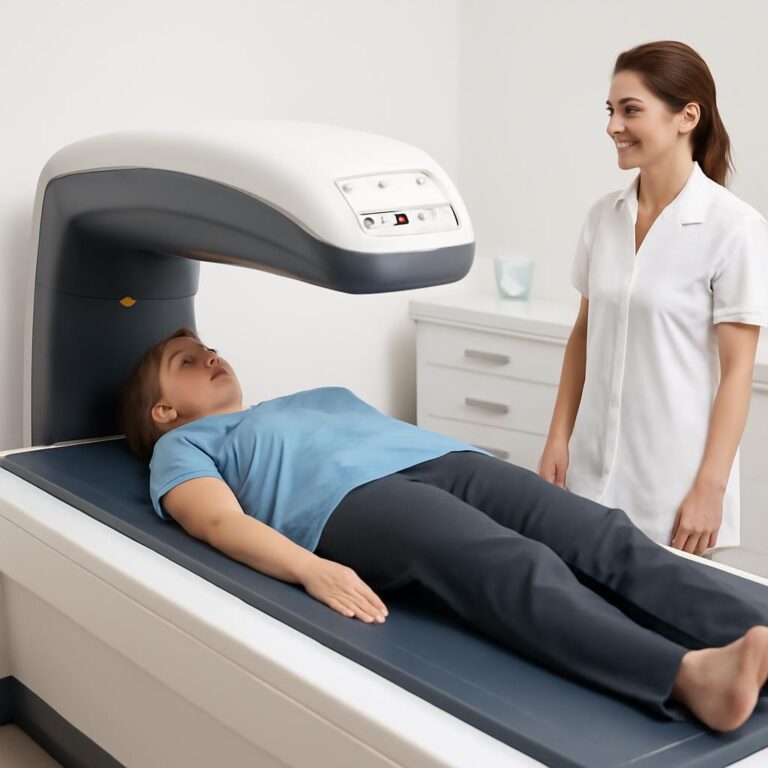
Start with the conversation, because everything else follows from knowing where you stand. Ask about a bone density scan if any of this applies: you are on or about to start ADT, you have taken oral steroids for more than three months, you have broken a bone from a minor fall since turning 50, you have lost height or developed a stooped upper back, you are a long-term smoker or heavy drinker, you are underweight, or a parent broke a hip. Otherwise, how often to get a DEXA scan after 50 covers the timing. Ask at the same appointment for the blood work that looks for a secondary cause: testosterone, vitamin D, calcium, kidney and liver function, thyroid function and celiac antibodies.
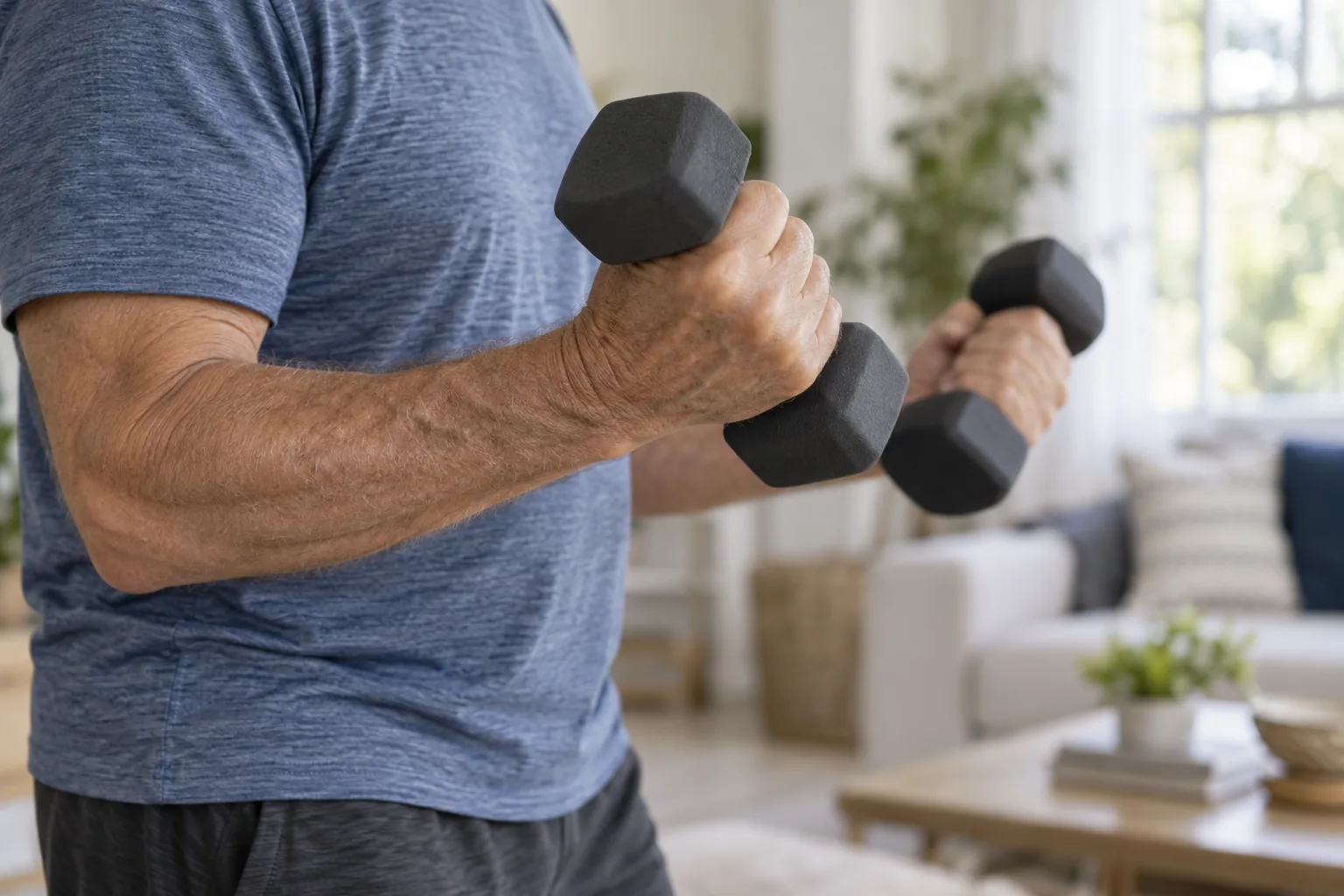
Then load the skeleton. Bone responds to force heavier or faster than what it has gotten used to, which is why walking maintains bone far better than it builds it. What shifts density in older adults is progressive resistance work through the hips and spine — squats, deadlifts, presses, with real weight and proper coaching — combined with brief impact, meaning movements where your feet leave the ground or land hard. A supervised high-intensity resistance and impact program in older men with low bone mass has shown measurable gains, which puts men in the unusual position of having direct evidence rather than extrapolation from trials in women. If you have not lifted since your thirties, strength training after 50 for bone health is the place to start, and a coach for the first months is money well spent. If you already have a diagnosis, get clearance first.
Some men want a structured framework rather than assembling one from scratch. If that is you, The Bone Density Solution packages the diet, movement and lifestyle side into one program, and our full review goes through what it does and does not include. Treat it as scaffolding around your medical care, never as a substitute for the scan, the blood work or the prescription.
Feed the process. Men who fall short on protein tend to be the ones losing weight, cooking less, or living alone after a bereavement — and low protein intake in an older man is a bone problem as much as a muscle one, as protein and bone health explains. Get calcium from food where you can, keep vitamin D adequate rather than heroic, and treat unintentional weight loss after 60 as a bone issue, because it costs you skeleton as well as muscle.
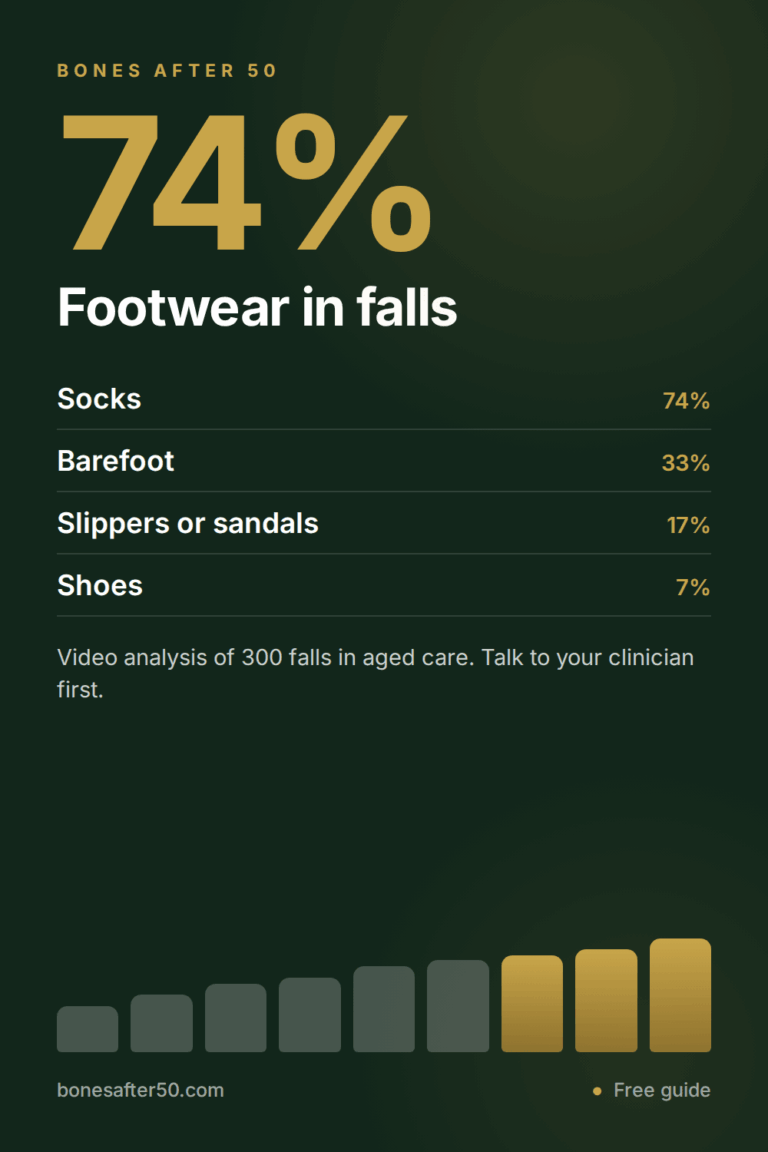
Then deal with the falls, because a strong bone that hits a tiled floor still breaks. This is the least glamorous and probably highest-yield item on the list: balance work, a review of the medications that make you dizzy, an eye test, and an honest walk around your own house looking at rugs, cables, stairs and the route from bed to bathroom in the dark. Fall prevention after 50 goes through it room by room. Men resist this one, as though a grab rail were an admission of something. It is an admission of arithmetic.
When Medication Earns Its Place
There is a point at which lifestyle alone stops being a reasonable plan, and it is not subtle. If you have already had a fragility fracture, if your bone density sits in the osteoporosis range, if your ten-year fracture risk is high, or if you are starting long-term steroids or androgen deprivation therapy, a conversation about drug treatment has earned its place alongside the training and the diet. Not instead of them. Alongside.
The honest caveat is that the evidence base in men is thinner. Most large fracture-outcome trials were run in postmenopausal women, and much of what we know about men comes from smaller studies using bone density as the endpoint, assuming the drugs behave similarly. That assumption is reasonable and broadly supported, but it is an assumption, and a good clinician will say so. Bisphosphonates are the most studied option in men, and there is specific evidence in men on ADT. The main osteoporosis medications compared covers how the classes differ and which side effects to ask about — take it to your appointment rather than deciding from a website.
None of this calls for alarm. Bone loss in men is slow, which is the whole problem and also the opportunity: a slope gives you years of warning that a cliff does not, provided somebody is looking. Most men reading this will not develop osteoporosis. The ones who do will mostly have a reason sitting in their notes already — a steroid prescription, a cancer treatment, a thyroid dose, a long relationship with alcohol. Finding it takes one appointment and a blood test. The alternative is finding out on a wet step on a Tuesday afternoon, with a bag of shopping in your hand.
The Bone Density Solution
A structured program designed for adults over 50 to support bone density through diet, exercise, and lifestyle changes — an integrated approach to reducing fracture risk. Best used alongside, not instead of, professional medical care.
Check The Bone Density Solution →Affiliate link — we may earn a commission at no extra cost to you. Full disclosure.
Sources
- National Institute of Arthritis and Musculoskeletal and Skin Diseases — osteoporosis in men, including why it is under-evaluated and under-treated after a fracture
- International Osteoporosis Foundation — epidemiology of osteoporosis and fragility fractures, including lifetime risk and hip fracture mortality in men
- International Society for Clinical Densitometry — 2023 Adult Official Positions on bone density testing and reference databases
- Endocrine Society — clinical practice guideline on osteoporosis in men, including diagnostic thresholds
- Bone Health & Osteoporosis Foundation — patient guidance on prevention, exercise, nutrition and fall prevention
Medical disclaimer: This article is for informational purposes only and is not medical advice. See our full medical disclaimer.