Balance Exercises to Prevent Falls and Fractures After 50
Disclosure: We may earn a commission if you purchase through links on this page. This does not affect our editorial assessment. See our affiliate disclosure.
Most bone health conversations focus on building density. But density alone doesn’t prevent fractures — what prevents fractures is not falling in the first place. The majority of osteoporotic fractures — including most hip fractures — result from falls. Which means that improving your balance and stability may be just as important as improving your bone density numbers.

Why Balance Declines After 50
Balance is a complex system involving three inputs: vision, the vestibular system (inner ear), and proprioception (the body’s sense of its own position in space). All three decline with age. Muscle strength — particularly in the legs, hips, and core — also decreases, which reduces the ability to react quickly when balance is disturbed.
The result: older adults are both more likely to fall and less able to catch themselves when they start to. This combination is what makes falls so dangerous for people with low bone density.
The good news is that balance is highly trainable at any age. Unlike some aspects of aging that are largely outside your control, balance responds meaningfully to targeted practice — and the improvements translate directly into reduced fall risk.
How Effective Is Balance Training?
Very effective. A Cochrane Review — the gold standard for systematic evidence reviews — examined over 100 trials and concluded that exercise programs including balance training reduce the rate of falls in older adults by approximately 23%, and the number of people who fall by around 15%. Programs combining balance, strength, and functional training showed the strongest results.
Tai chi, in particular, has a strong evidence base for fall prevention in older adults — consistently outperforming many other interventions in head-to-head trials. More on that in a separate article, but it’s worth mentioning here because it’s often dismissed as too gentle to be effective. The research says otherwise.
Core Balance Exercises to Practice Daily
These exercises require no equipment and can be done at home. Start with the easier variations and progress as your stability improves. Always practice near a wall or sturdy chair for safety.
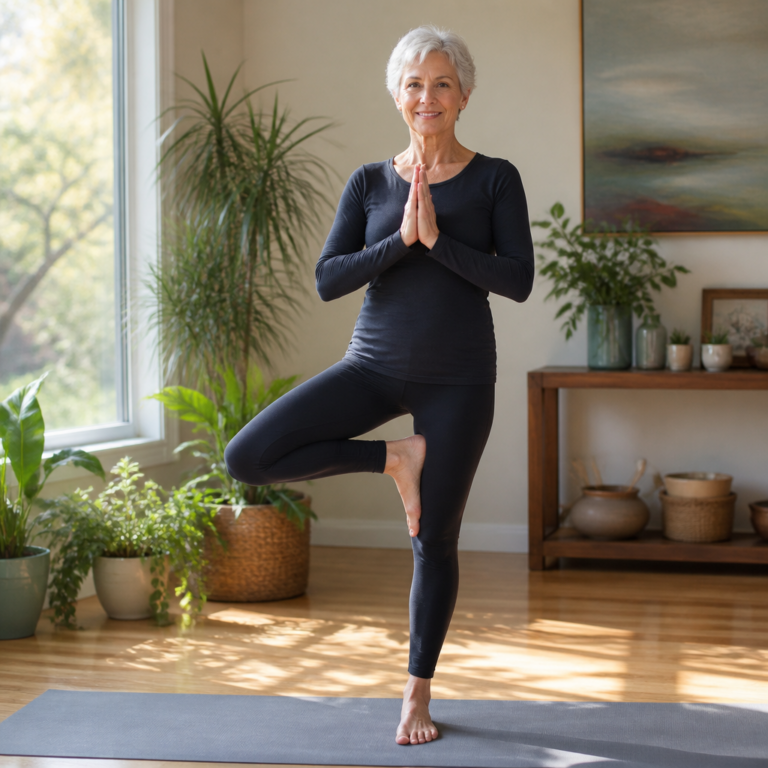
1. Single-Leg Stand
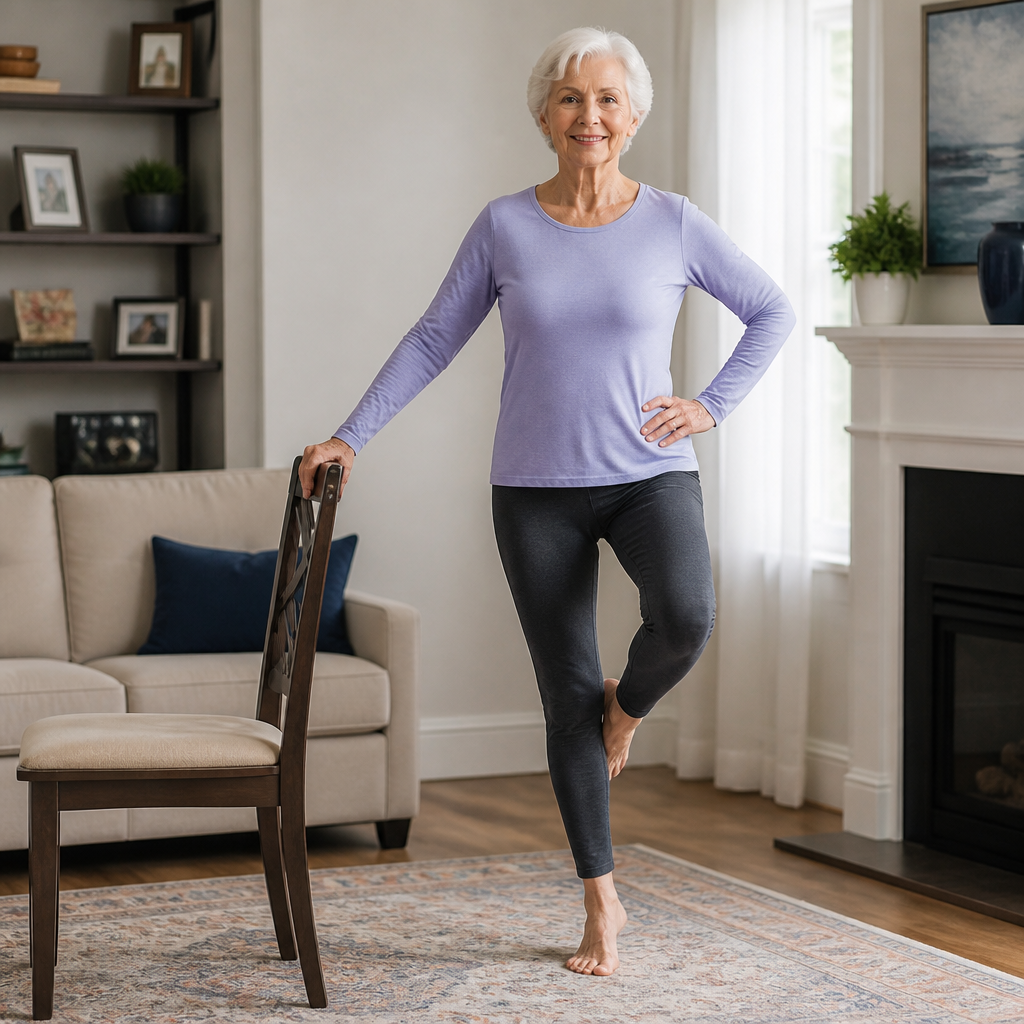
Stand on one foot, keeping the other foot slightly raised. Hold for 10–30 seconds, then switch. This is the foundational balance exercise. Progress by: closing your eyes (much harder), standing on a folded towel or cushion, or adding small arm movements. Aim for 3 rounds on each side daily.
2. Heel-to-Toe Walk (Tandem Walk)
Walk in a straight line, placing the heel of one foot directly in front of the toes of the other with each step — like walking a tightrope. Walk 10–20 steps forward, then backward. This challenges dynamic balance (balance during movement), which is more relevant to fall prevention than static balance alone.
3. Weight Shifts
Stand with feet hip-width apart. Slowly shift your weight onto one foot until you lift the other slightly, hold 2–3 seconds, then shift to the other side. Repeat 10–15 times each side. Simple but effective for training the side-to-side stability that catches you when you trip.
4. Sit-to-Stand (No Hands)
From a chair of normal height, stand up without using your hands — then sit back down slowly and with control. This trains leg strength and balance simultaneously, and directly mimics one of the most common fall-risk situations: getting up. Aim for 10 repetitions. As this becomes easy, lower the chair height or slow the movement further.
5. Standing Hip Abduction
Hold a chair for light support. Stand on one leg and slowly lift the other leg out to the side, hold 2 seconds, then lower. Repeat 12–15 times on each side. This strengthens the hip abductors — the muscles that control lateral stability and are critical for catching yourself during a stumble.
6. Backward Walking
Walk backward slowly, 10–20 steps at a time, in a safe space. Backward walking activates different muscle groups and balance systems than forward walking and is associated with improved balance and gait in older adults. Start near a wall for safety.
7. Staggered Stance
Stand with one foot a half-step ahead of the other (not full tandem, but offset). Hold for 20–30 seconds, then switch feet in front. This semi-tandem stance challenges balance in a way that’s intermediate between feet together and full tandem — useful for progressive training.
Integrating Balance Training Into Your Routine
Balance training doesn’t require dedicated sessions — it can be woven into daily life. Practice single-leg stands while brushing your teeth. Do heel-to-toe walking in your hallway. Perform sit-to-stands each time you get up from a chair rather than pushing up with your hands.
For structured practice, 10–15 minutes of balance-focused exercise 3–5 days per week is well-supported by the research. Combined with strength training (2–3 days per week), this combination addresses both the bone density and fall prevention sides of fracture risk simultaneously.
Environmental Fall-Proofing
Balance training addresses the internal factors in fall risk. It’s worth also addressing the external ones: remove loose rugs, ensure adequate lighting especially at night, install grab bars in bathrooms, keep frequently used items at accessible heights, and use appropriate footwear (supportive, low-heeled, non-slip). These changes take minutes and can eliminate common fall triggers entirely.
For a complete approach to bone health that integrates exercise, nutrition, and lifestyle habits, The Bone Density Solution offers a structured daily program designed for adults over 50.
Related articles:
7 Best Exercises to Improve Bone Density After 50
Strength Training After 50: A Beginner’s Guide for Bone Health
Warning Signs of Low Bone Density You Shouldn’t Ignore
Who Should Be Careful With Balance Exercises
Balance exercises are specifically designed to reduce fall risk, but they should be approached with care if:
- You already have significant balance problems or a history of recent falls
- You have inner ear conditions, vertigo, or dizziness
- You have peripheral neuropathy or reduced sensation in your feet
- You are recovering from a fracture or lower limb injury
Always practice balance exercises near a wall or sturdy chair for support. If you have had a recent fall or have a medical condition affecting your balance, ask your GP for a falls assessment before beginning.
Sources and Further Reading
This article is for educational purposes only and does not replace advice from a qualified healthcare professional.
The Bone Density Solution
A structured program specifically designed for adults over 50 to improve bone density through diet, exercise, and lifestyle changes. Takes an integrated approach to reducing fracture risk.
Check The Bone Density Solution →Affiliate link — we may earn a commission at no extra cost to you. Full disclosure.
Disclosure: This article contains affiliate links. We may earn a small commission if you purchase through our links, at no extra cost to you.
Medical disclaimer: This article is for informational purposes only and is not medical advice. Consult your physician before changing supplements, medications or exercise routines, especially if you have been diagnosed with osteopenia or osteoporosis. See our full medical disclaimer.