Resistance Band Exercises for Bone Density
Disclosure: This article contains affiliate links. We may earn a small commission if you purchase through our links, at no extra cost to you.
Resistance bands are often seen as beginner equipment — something you graduate away from as you get stronger. For bone health purposes, that’s a misconception worth correcting. Bands can generate substantial resistance, load the specific muscle groups that pull on fracture-prone bones, and be used anywhere. They’re a genuinely useful tool for bone health at any fitness level.
How Resistance Bands Build Bone
The principle is the same as with free weights: when muscles contract against resistance, they pull on the bones they attach to. This tensile stress stimulates osteoblast activity and bone formation. The advantage of bands is variable resistance — the tension increases as the band stretches, meaning the hardest part of the movement occurs at the end range where muscles are typically strongest. This matches the strength curve well and reduces injury risk at vulnerable points of the movement.
Best Resistance Band Exercises for Bone Health
Hip Abduction (targets femoral neck — highest fracture risk)
Loop a band just above the knees. Stand on one leg, hold a chair for light support, and push the other leg out to the side against the band resistance. 12–15 reps each side, 3 sets. Directly loads the hip abductors and femoral neck.
Banded Squat (targets hip, femur, spine)
Band above knees, feet hip-width apart. Squat down to chair height, pushing knees outward against the band, then stand. 3 sets of 10–12. The band adds hip abductor engagement to the squat, increasing hip loading.
Standing Row (targets upper spine, shoulders)
Anchor band at chest height to a door or post. Hold both ends, step back to create tension, and pull elbows back toward your sides. 3 sets of 12–15. Loads the thoracic spine and shoulder girdle — important for vertebral bone health.
Pull-Apart (targets upper back)
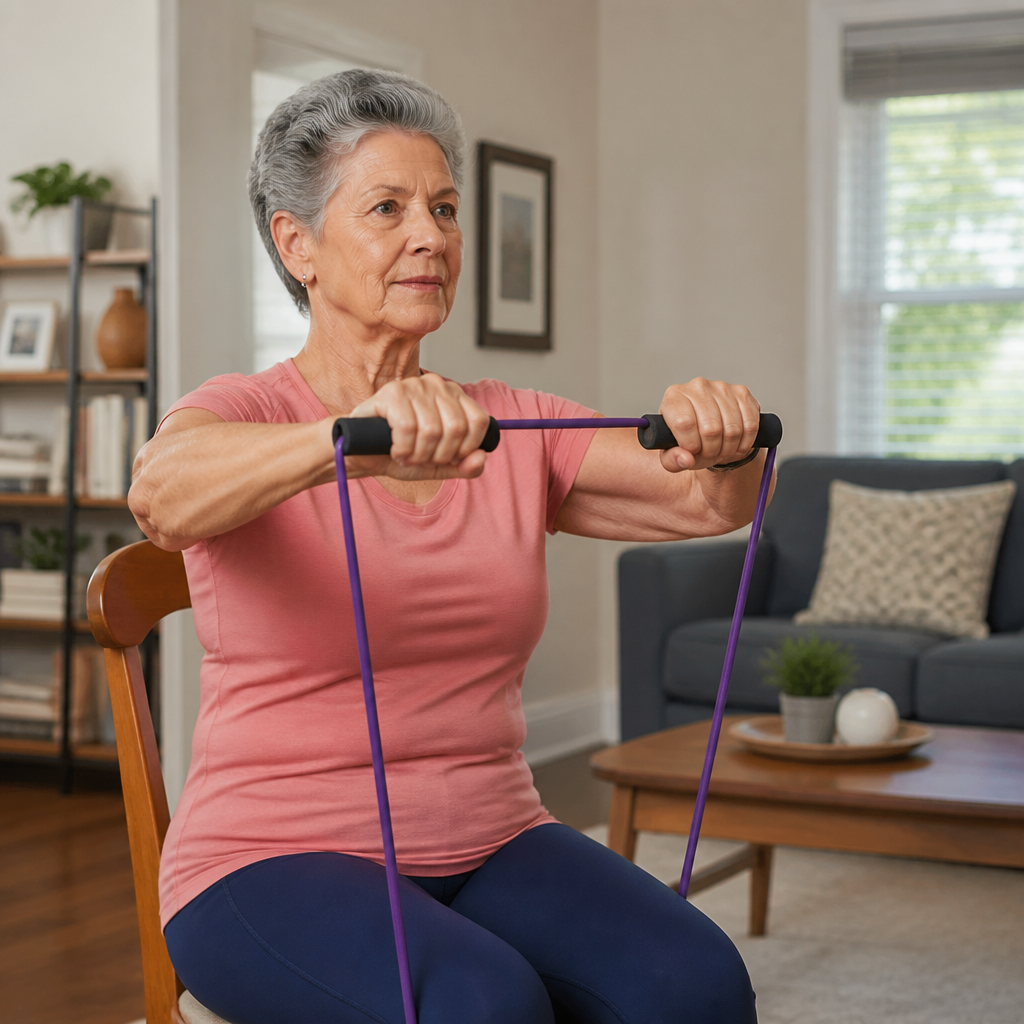
Hold band with both hands at shoulder width, arms extended in front. Pull the band apart horizontally until arms are wide, squeezing shoulder blades together. 3 sets of 15. Strengthens the posterior chain of the upper back.
Banded Deadlift / Hip Hinge (targets femoral neck, spine)
Stand on the band, holding both ends. Hinge at the hips, keeping back flat, then drive hips forward to stand tall. 3 sets of 10. One of the most effective exercises for hip bone loading with bands.
Wrist Extension and Flexion (targets distal radius — common fracture site)
Sit with forearm resting on thigh. Loop band under foot, hold the other end. Extend wrist upward against resistance, then flex downward. 15 reps each direction, 2 sets. Directly loads the forearm bones that break in wrist fractures.
Progression and Intensity
For bone benefits, resistance needs to be challenging — you should feel significant effort in the last 2–3 reps of each set. Move to heavier resistance bands as exercises become comfortable. A set of bands in light, medium, and heavy resistance covers all these exercises and costs relatively little.
For a complete, structured bone health program, The Bone Density Solution integrates exercise and nutrition guidance for adults over 50.
Related articles:
Strength Training After 50: A Beginner’s Guide
7 Best Exercises to Improve Bone Density After 50
Balance Exercises to may help reduce the risk of Falls and Fractures
Who Should Be Careful With Resistance Band Training
Resistance bands are low-impact and generally well-tolerated, but some people should take precautions:
- Those with shoulder, wrist, or elbow injuries that could be aggravated by pulling movements
- Anyone with a recent fracture or who has been advised to limit loading
- People with grip difficulties or arthritis in the hands
- Those new to resistance exercise — start with very light resistance and progress slowly
If you are unsure about the appropriate resistance level or technique, a session with a physiotherapist or exercise professional can help you get started safely.
Sources and Further Reading
- BHOF — Exercise and Safe Movement
- CDC STEADI — Fall Prevention for Older Adults
- Mayo Clinic — Osteoporosis and Exercise
This article is for educational purposes only. Always consult a qualified healthcare professional before starting a new exercise programme, especially if you have osteoporosis, a history of fractures or balance difficulties.