Vitamin K2 and Bone Health After 50: What to Know
Disclosure: We may earn a commission if you purchase through links on this page. This does not affect our editorial assessment. See our affiliate disclosure.
Calcium and vitamin D are widely recommended for bone health. Vitamin K2 is less commonly discussed, and the evidence around its role in calcium metabolism is worth understanding.
Calcium metabolism in the body is complex, and researchers have been examining how different nutrients — including vitamin K2 — may influence how calcium is processed. Without the right biochemical signals, calcium absorbed from food or supplements can end up depositing in soft tissues instead. Vitamin K2 is involved in proteins that influence where calcium is processed in the body, though the clinical significance of this for bone health in humans is still being studied.
What Is Vitamin K2?
Vitamin K is a fat-soluble vitamin that comes in two main forms: K1 (phylloquinone) and K2 (menaquinone). K1 is found primarily in leafy green vegetables and is mostly involved in blood clotting. K2 is found in fermented foods and some animal products, and it has a distinct and important role in bone and cardiovascular health.
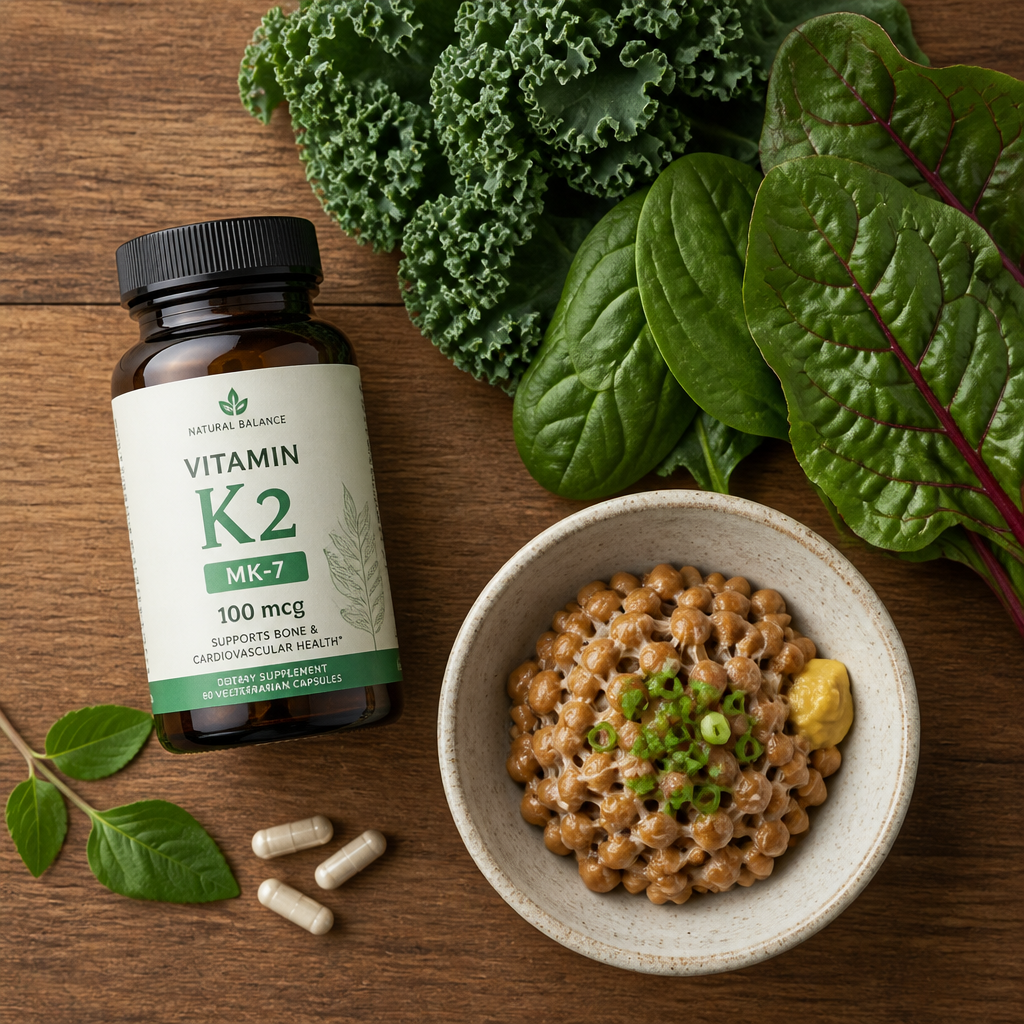
K2 exists in several subtypes, the most studied of which are MK-4 and MK-7. MK-7, which comes primarily from natto (a fermented soybean dish common in Japan), has a much longer half-life in the body and is the form most often studied in the context of bone health.
How Vitamin K2 Supports Bone Health
K2 activates two key proteins that are critical for bone metabolism:
Osteocalcin is a protein produced by osteoblasts (the cells that build bone). In its inactive form, it can’t bind to calcium. Vitamin K2 activates osteocalcin through a process called carboxylation, allowing it to grab calcium and incorporate it into the bone matrix. Without adequate K2, osteocalcin remains inactive — and calcium can’t do its job in your bones.
Matrix Gla Protein (MGP) is found in soft tissues including blood vessel walls. When activated by K2, MGP inhibits calcium from depositing in the arteries. This is why K2 is often discussed in the context of both bone health and cardiovascular health — it helps keep calcium in bones and out of arteries.
What the Research Says
Several studies have examined the relationship between K2 and bone density. Research published in Osteoporosis International found that supplementation with MK-7 significantly improved bone strength indices in postmenopausal women over a three-year period. Other studies have shown associations between higher K2 intake and lower rates of hip fracture in older adults.
A large prospective study in Japan found that populations consuming natto regularly — which is extremely high in MK-7 — had notably lower rates of hip fractures compared to regions where natto consumption is low. While diet is complex and this isn’t proof of causation, it’s consistent with the mechanistic evidence.
It’s worth noting that most Western diets are quite low in K2. K1 is abundant in vegetables, but the conversion from K1 to K2 in the body is limited and unreliable. The main dietary sources of K2 are hard cheeses, egg yolks, liver, and fermented foods like natto and some fermented cheeses — foods that many people don’t eat in large quantities.
Vitamin K2 and Vitamin D: A Critical Partnership
Vitamin D increases calcium absorption from the gut. That’s generally a good thing — but if K2 is deficient, that additional calcium may not be directed properly into bones. Some researchers argue that vitamin D supplementation without adequate K2 could theoretically increase the risk of arterial calcification over time, though this remains an area of ongoing research.
What most bone health experts agree on is this: calcium, vitamin D, and K2 work together as a system. Optimizing just one piece without the others may leave results on the table.
How Much K2 Do You Need?
There is no official Recommended Daily Allowance (RDA) for vitamin K2 specifically in most countries — the existing recommendations cover total vitamin K without distinguishing between K1 and K2. However, based on available research:
- Studies showing bone benefits have typically used 90–180 mcg of MK-7 per day
- Some researchers suggest that 100–200 mcg of MK-7 daily is a reasonable target for bone health support
- MK-4 has been studied at much higher doses (45 mg/day) in Japanese clinical trials, but MK-7 at lower doses appears similarly effective due to its longer half-life
If you’re taking a vitamin D supplement, it’s worth looking for formulas that combine D3 with K2 (MK-7), as many quality supplements now do.
Food Sources of Vitamin K2
| Food | Approximate K2 Content | Notes |
|---|---|---|
| Natto (fermented soybeans) | ~850–1000 mcg per 100g | Exceptionally high in MK-7 |
| Hard cheese (Gouda, Brie) | ~75 mcg per 100g | Good everyday source |
| Egg yolk | ~15–30 mcg per yolk | Mostly MK-4 |
| Chicken liver | ~14 mcg per 100g | MK-4 form |
| Butter (grass-fed) | ~15 mcg per 100g | Higher in K2 than grain-fed |
Unless you eat natto regularly, getting therapeutic amounts of K2 from diet alone is difficult. This makes K2 supplementation worth considering for many people focused on bone health.
Is K2 Safe?
Vitamin K2 has a very good safety profile. Unlike some fat-soluble vitamins, toxicity from K2 supplementation has not been reported even at higher doses. The main caution: people taking blood-thinning medications like warfarin (Coumadin) should consult their doctor before adding any vitamin K supplement, as K can affect how these medications work.
Adding K2 to Your Bone Health Routine
If you’re already taking calcium and vitamin D for bone health, adding K2 is a relatively simple upgrade that many healthcare providers now recommend. Look for supplements containing MK-7 (derived from natto) at doses of 100–200 mcg.
Bone health is most effective when approached as a complete system — nutrition, targeted supplementation, weight-bearing exercise, and healthy lifestyle habits working together. For a structured program that addresses all these elements, The Bone Density Solution offers a practical, day-by-day guide designed specifically for adults over 50.
As always, discuss any new supplements with your doctor or pharmacist — especially if you have existing health conditions or take prescription medications.
Related articles:
Calcium, Vitamin D & Beyond: What Your Bones Need
The Best Foods for Stronger Bones
Osteoporosis Prevention: Habits That Make a Difference
Related Articles
The Bone Density Solution
A structured program specifically designed for adults over 50 to improve bone density through diet, exercise, and lifestyle changes. Takes an integrated approach to reducing fracture risk.
Check The Bone Density Solution →Affiliate link — we may earn a commission at no extra cost to you. Full disclosure.
Sources and Further Reading
- NIH Office of Dietary Supplements — Vitamin K: Fact Sheet for Health Professionals
- Bone Health & Osteoporosis Foundation — Nutrition for Bone Health
- Akbulut et al. (2018) — Vitamin K2 and bone health: a review. Journal of Bone and Mineral Metabolism
- Mayo Clinic — Vitamin K
Disclosure: This article contains affiliate links. We may earn a small commission if you purchase through our links, at no extra cost to you.
MK-4 vs MK-7 — which form to choose
Vitamin K2 comes in several molecular forms (menaquinones, abbreviated MK-n), but the two relevant for bone health are MK-4 and MK-7. Most of the post-menopausal trials that showed bone density and fracture benefit used MK-7 specifically, and almost all current supplementation recommendations target that form.
The relevant differences:
- MK-7 has a much longer half-life in plasma — roughly 3 days vs hours for MK-4. This means a single daily dose of MK-7 maintains stable blood levels, while MK-4 needs to be taken several times a day to do the same job.
- MK-7 is the form found in fermented foods like natto. MK-4 is produced in small amounts in animal tissue and is found in modest amounts in meat, eggs and dairy.
- The clinical trial doses differ. MK-7 trials use 90-180 mcg daily; MK-4 trials typically use 45 mg (note: milligrams, not micrograms — a much higher absolute dose).
- MK-7 supplements are more widely available in the doses the bone literature supports. Most reputable supplement brands sell MK-7 in capsules at 90, 100, or 180 mcg.
The practical recommendation: for bone health supplementation in adults over 50, choose MK-7 at 180 mcg daily, taken with a meal containing some fat (improves absorption). This matches the dose used in the strongest published bone-health trials. MK-4 is not wrong, but it’s harder to dose correctly and the per-day capsule count is impractical.
K2 in the context of a complete bone-health protocol
K2 on its own is not a complete bone-health intervention — it’s a critical missing piece of a system that also needs loaded weight-bearing exercise, adequate protein intake, vitamin D at functional blood levels, and magnesium. We cover the full four-pillar protocol in our review of The Bone Density Solution, which most of our readers gravitate toward as a structured 12-month plan.
Read our full Bone Density Solution review →The warfarin caveat — read this if you take a blood thinner
The newer direct oral anticoagulants (DOACs) — apixaban (Eliquis), rivaroxaban (Xarelto), dabigatran (Pradaxa), edoxaban (Savaysa) — do not have the same vitamin K interaction. If you’re on a DOAC rather than warfarin, K2 supplementation can be added without the same INR concerns. Still discuss with your physician, but the interaction concern is not the same.
Related reading from elsewhere: Vitamin K2 also has implications for the calcium balance in oral tissue and saliva. If oral health is also a concern, this companion piece on vitamin D and teeth covers the dental side of the same nutrient story.
Medical disclaimer: This article is for informational purposes only and is not medical advice. Consult your physician before changing supplements, medications or exercise routines, especially if you have been diagnosed with osteopenia or osteoporosis. See our full medical disclaimer.