
Vitamin D Dose for Bone Health After 50: What the Research Supports
The official RDA for vitamin D in adults over 50 is 600-800 IU per day. The bone-health trials that actually show measurable benefit used 1,500-4,000 IU per day, with serum target ranges of 30-50 ng/mL (75-125 nmol/L). This gap matters.
Why the RDA is set so low
The RDA is calibrated to prevent rickets and osteomalacia in the general population. It is not calibrated to optimize bone density in post-menopausal women, support calcium absorption at maximum capacity, or maintain serum 25-OH-D in the 30-50 ng/mL range that the bone literature targets.
Get your blood level measured first
Before deciding on a dose, ask for a 25-hydroxy vitamin D test. Most adults over 50 in higher-latitude countries (and many in lower-latitude ones with indoor lifestyles) sit below 25 ng/mL — clinically insufficient even by RDA standards.
The dosing ranges that match the published trials
- Maintenance for someone already at 30-40 ng/mL: 1,000-2,000 IU per day, typically year-round.
- Building up from 15-25 ng/mL: 2,000-4,000 IU per day for 3-4 months, then retest, then taper to maintenance.
- Severe deficiency (under 15 ng/mL): usually a short loading dose under medical supervision (50,000 IU weekly for 8-12 weeks), then retest.
Pair with K2 and magnesium
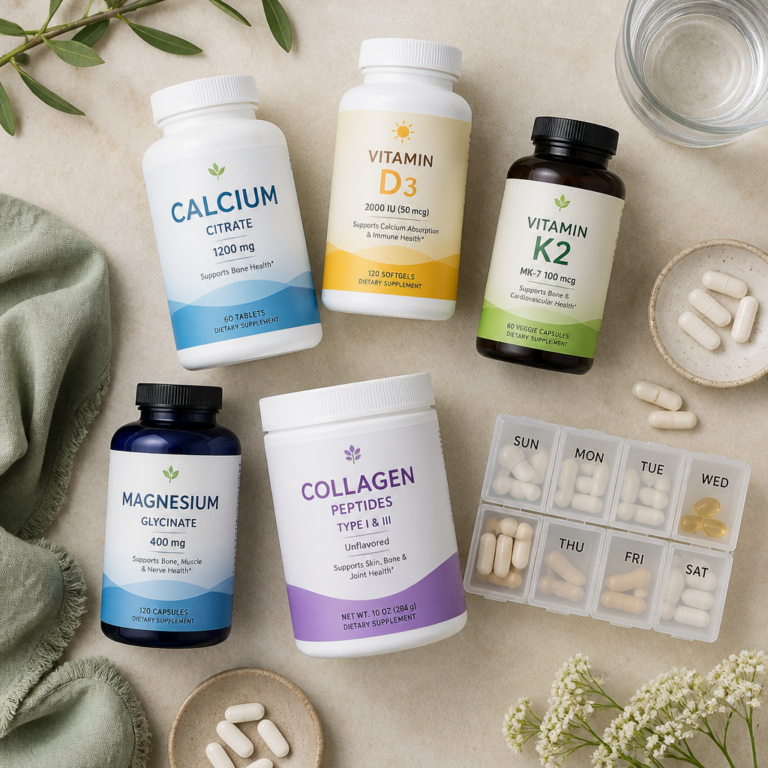
Vitamin D opens the door for calcium absorption. Without vitamin K2, that absorbed calcium does not get directed to bone reliably. Without magnesium, vitamin D activation is impaired. The three nutrients work as a system; isolating one is much weaker than the combination. If you would rather follow the stack as a single plan than assemble it yourself, we looked at a programme built around exactly that D-K2-magnesium combination.
Practical product notes
- D3 (cholecalciferol) is the form to choose. D2 is less effective.
- Take with a meal that contains fat — absorption is meaningfully better.
- Liquid drops are fine; tablets are fine; no clinical difference between forms at typical doses.
- Check the label for the actual IU per dose; some products are sold in microgram (mcg) units (1 mcg = 40 IU).
FAQ
How much vitamin D is too much?
Daily intake under 4,000 IU is generally safe long-term for adults. Above that, monitor serum level; toxicity is rare under 10,000 IU/day but can occur over months at very high doses.
Should I get my D from sun rather than supplements?
Sun is great when you can get it. Realistic for many adults at higher latitudes, only 4-6 months of the year actually produce skin vitamin D. Supplementation fills the gap.
Why do some doctors still target only 20 ng/mL?
The Endocrine Society guideline targets 30 ng/mL specifically for bone-health outcomes; some primary care still uses the lower RDA-derived threshold. The bone literature supports the higher target.