Can You Build Bone Density After 50? What’s Actually Possible
Disclosure: We may earn a commission if you purchase through links on this page. This does not affect our editorial assessment. See our affiliate disclosure.
A reader wrote to us last month with a question she said had been nagging at her since her last scan: “Is the bone I have right now the most I’m ever going to have?” She’s 58. She’d read somewhere that it’s all downhill after menopause, and she wanted to know whether the walking and the calcium chews were doing anything at all. It’s a fair question, and a common one, so let’s answer it plainly.
You can build bone after 50. You can more reliably hold onto the bone you’ve got and slow the slide that tends to come with age. But the size of the gain, how quickly it shows up, and who benefits most all hinge on two things: where you’re starting from, and what you’re actually willing to do week after week. No miracle here, and no reason to be frightened either. Just a realistic look at the numbers.
Mostly you maintain — and a little gain is on the table
For most people past 50, the honest headline goal is to keep the bone you have and blunt the natural decline. That alone is worth a lot. On top of it, genuine gains in bone mineral density do happen, but they’re usually modest — think somewhere in the neighborhood of 1 to 3 percent over a year or more of consistent, pointed effort. If you were hoping to hear “reverse it completely,” I’d rather be straight with you now than sell you a fantasy.
Here’s the encouraging part. The people who tend to see the clearest wins are those sitting in the osteopenia range — bone that’s lower than normal but hasn’t crossed into osteoporosis. If that’s you, exercise and everyday habits can carry a lot of the weight on their own. If you’re already in osteoporosis territory, the same habits still matter and still help, but the evidence is clear that most people also need medication to bring fracture risk down in a way that actually counts. It’s not a failure to need the drug; it’s just how the biology works. Our broader guide on how to reverse bone loss naturally pulls these threads together if you want the full strategy.
Why it gets harder after 50 — not why it’s hopeless
Bone isn’t the inert scaffolding people imagine. It’s living tissue, torn down and rebuilt constantly. Up until roughly age 30 you build more than you lose. After that the ledger slowly flips, and for women the estrogen drop around menopause speeds things up sharply — the steepest losses often land in those first several years afterward. Men lose bone too; it just happens later and more gently.
Stack on slower recovery, shrinking muscle, and the plain fact that most of us move less and lift less than we did at 35, and you can see why the deck feels stacked. But none of that means your skeleton is set in stone. Bone answers to load its whole life. The signals that tell it to hold on to mineral, or add a bit — force, impact, a challenge that keeps rising — still land in your fifties, sixties, and seventies. The catch is that you now have to supply those signals on purpose. They no longer show up by accident.
What actually moves the needle
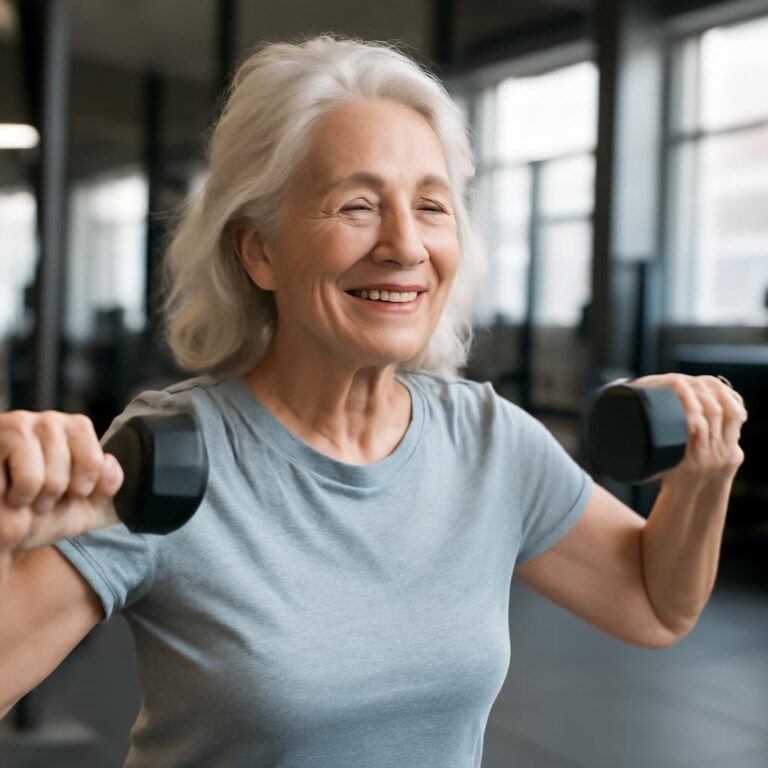
If one finding towers over the rest, it’s that bone responds to meaningful mechanical load — real resistance, real impact. The LIFTMOR trial (its full name is Lifting Intervention For Training Muscle and Osteoporosis Rehabilitation) is the one researchers keep coming back to. Run in postmenopausal women with low bone mass, it put participants through supervised high-intensity resistance and impact work — heavy deadlifts, overhead presses, jumping-style loading — and saw bone density improve at the spine, alongside better strength and function, with a reassuringly strong safety record when the coaching was good. A later trial in older men, LIFTMOR-M, pointed the same way.
Don’t read that as “go load a heavy barbell tomorrow.” Read it as this: progressive resistance training — nudging the challenge upward over time — paired with some impact is the most dependable thing you can do for bone. That word progressive is doing a lot of work, and we’ll come back to it. For the how, our pieces on strength training after 50 for bone health and the best exercises to improve bone density after 50 walk through building up without hurting yourself, and weight-bearing exercise after 50 handles the impact side.
Loading the skeleton is the headline act, but a few things back it up. Protein is one people overlook. Bone isn’t all mineral — close to half its volume is a protein-based collagen matrix — so getting enough feeds both the bone and the muscle that tugs on it. Plenty of older adults quietly fall short, and spreading protein across the day is an easy fix; our overview of protein and bone health digs into the targets. Then there’s the calcium, vitamin D, and vitamin K2 crowd. These are supporting players, full stop. Calcium and vitamin D are the raw materials and the regulators; run short on them and you’ll undercut everything else. K2 helps steer calcium into bone. The nuance worth remembering: fixing a real deficiency helps, but stacking megadoses on top of an already-adequate intake doesn’t buy you extra bone, and can carry its own risks. Aim for sufficiency, ideally with your clinician and a blood test rather than guesswork. And don’t discount the boring stuff — decent sleep, not smoking, keeping alcohol moderate. None of it builds bone on its own, but each one removes a headwind that’s quietly working against you.
What won’t build bone, even though we wish it would
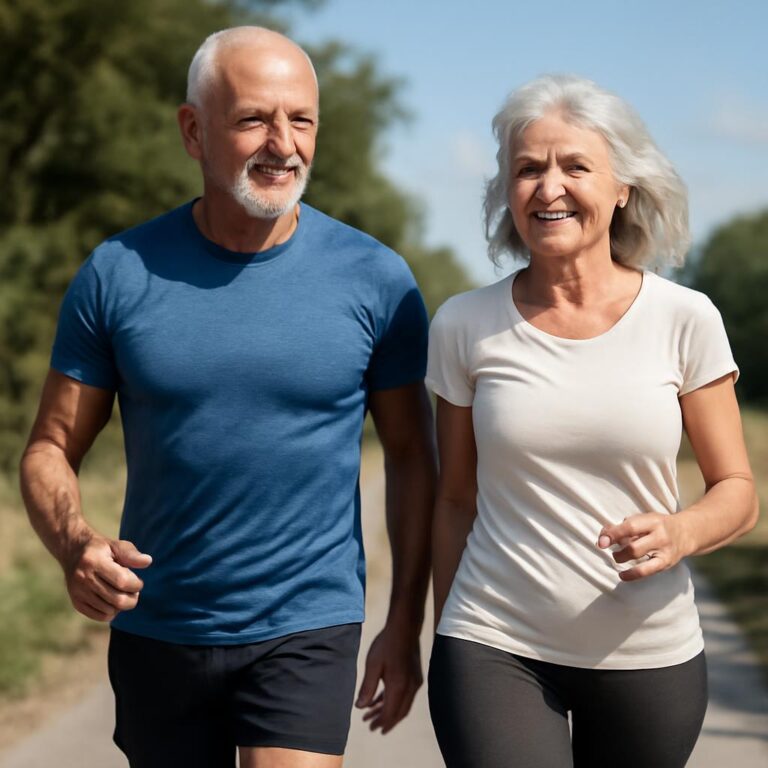
Knowing what doesn’t work saves you months. Walking is the big one people are surprised by. It’s genuinely good for your heart, your mood, your everything — and it beats sitting by a mile — but at a normal pace it just doesn’t deliver enough novel load to build density on its own. Keep walking; treat it as the floor you build on, not the whole house. Light weights and gentle circuits fall into the same trap: if the resistance never becomes hard, bone never gets a reason to adapt. The load has to keep creeping upward, which is that word progressive again. And supplements, taken by themselves, won’t do it either. Past correcting a true calcium or vitamin D shortfall, no pill — including the popular bone formulas — substitutes for putting mechanical stress through your skeleton. There’s no swallowing your way to stronger bone.
The numbers, and how long it really takes
This is where I want to be most careful with you. When bone density does improve through exercise and lifestyle, the change usually lands around 1 to 3 percent over roughly 12 to 18 months of steady work. Some people see a touch more, some less, and it swings with your starting point, your hormones, and how progressive the training actually was. That figure can feel underwhelming until you remember the default after 50 is slow loss. Against that backdrop, holding flat — let alone ticking up — is a real win, because even preventing decline pulls down your future fracture risk.
Bone also remodels slowly, so patience isn’t optional. Meaningful change unfolds over months and years, not weeks, which is exactly why a DEXA scan usually gets repeated every one to two years rather than constantly — measure too often and you’re mostly reading noise, not progress. Your doctor will set the right interval based on your numbers and risk. And to say it once more, plainly: if you already have osteoporosis, the exercise and the nutrition are worth doing, but on their own they generally won’t haul density back into a safe range or cut fracture risk the way medication can. This is a both/and, not an either/or. The habits make the medication work better, and the reverse holds too.
A simple place to start
If your doctor has cleared you to exercise, here’s a framework you can grow into. Move up gradually, and get some early coaching on form if you’re new to lifting or working around a diagnosis — it’s the cheapest injury insurance there is.
- Resistance training, 2 to 3 days a week. Lean on compound moves that load the hips and spine — squats or sit-to-stands, hinges and deadlift variations, presses, rows. Start where it’s manageable and add small increments.
- Some impact, on the days you can. Heel drops, controlled hops, step-downs — scaled to you and okayed by your clinician. Short bouts still count.
- Train your balance. Not falling is half of fracture prevention. Single-leg holds and slow, controlled drills go a surprisingly long way.
- Feed it. Enough protein across the day, plus sufficient calcium and vitamin D.
- Show up, and track the long arc. Bone rewards persistence. Let your DEXA cadence tell the story, not the bathroom scale.
If you’d rather not piece all of this together yourself, a structured program can hand you the sequencing — which is part of why we point readers toward The Bone Density Solution, a diet-and-exercise plan built for adults over 50. Use it alongside your doctor’s guidance, never in place of it, and treat it as scaffolding for the habits above rather than a shortcut around them. We go through its four pillars, and its limits, in a longer look at the program.
So, is it too late at 60 or 70? No — and that’s not a pep talk, it’s what the trials show. Studies that included women and men in their sixties and seventies found real improvements in density, strength, and function from supervised, progressive training. The rules don’t change with age: start where you are, build slowly, get proper guidance, and lean on that guidance harder if you already have low density or a fracture behind you. The bone you have isn’t the ceiling. It’s the floor you get to work from.
Sources
- National Institute of Arthritis and Musculoskeletal and Skin Diseases (NIAMS) — Osteoporosis
- Bone Health & Osteoporosis Foundation (BHOF)
- Mayo Clinic — Osteoporosis
- Watson et al., LIFTMOR randomized controlled trial (Journal of Bone and Mineral Research)
The Bone Density Solution
A structured program designed for adults over 50 to support bone density through diet, exercise, and lifestyle changes — an integrated approach to reducing fracture risk. Best used alongside, not instead of, professional medical care.
Check The Bone Density Solution →Affiliate link — we may earn a commission at no extra cost to you. Full disclosure.
Medical disclaimer: This article is for informational purposes only and is not medical advice. Consult your physician before changing supplements, medications or exercise routines. See our full medical disclaimer.