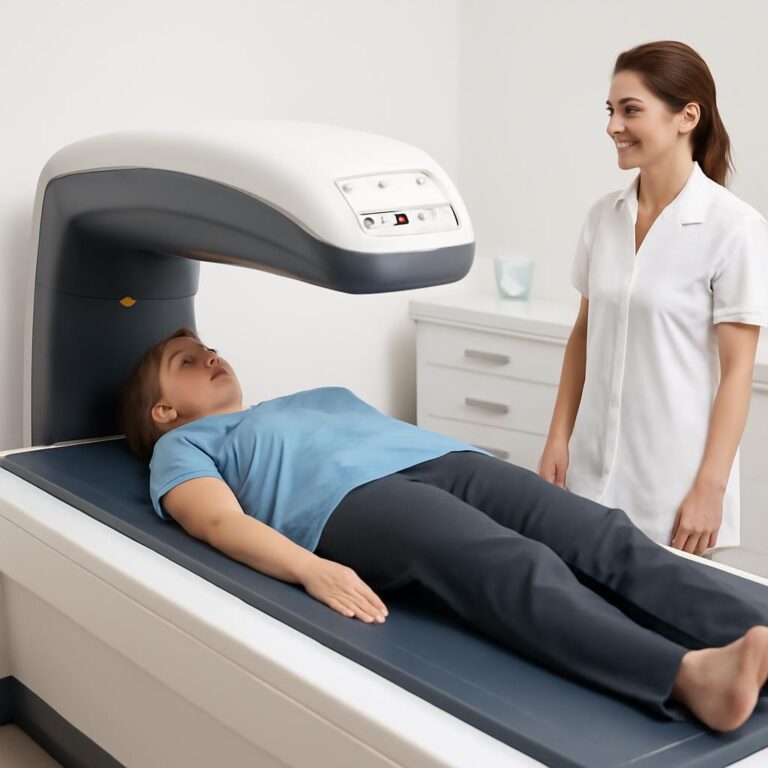

DEXA Scan Results Explained: What Your T-Score and Z-Score Really Mean
Disclosure: We may earn a commission if you purchase through links on this page. This does not affect our editorial assessment. See our affiliate disclosure.
In this article
- What DEXA actually measures
- T-score: comparison to young healthy reference
- Z-score: comparison to age-matched reference
- Site-specific reading
- What changes between scans
- Practical actions by T-score
- FAQ
A DEXA scan produces several numbers, and most patients leave the appointment without fully understanding what they mean. Here is the practical translation, plus what each number changes about what you should do next.
What DEXA actually measures
Dual-energy X-ray Absorptiometry measures bone mineral content at specific sites — usually the lumbar spine, total hip, and femoral neck. The scan takes 10-20 minutes, the radiation dose is roughly equivalent to a transatlantic flight, and results are typically available within days.
T-score: comparison to young healthy reference
T-score compares your BMD to a healthy 30-year-old of the same sex. T-score above -1.0: normal. T-score between -1.0 and -2.5: osteopenia (low bone mass). T-score at or below -2.5: osteoporosis. T-score at or below -2.5 with prior fragility fracture: severe osteoporosis. These cutoffs are international consensus.
Z-score: comparison to age-matched reference
Z-score compares your BMD to others your same age and sex. A Z-score below -2.0 is concerning — it means your bone loss is disproportionate to expected aging. This often prompts workup for secondary causes (hyperparathyroidism, malabsorption, medications, hormonal issues).
Site-specific reading
The lumbar spine, total hip, and femoral neck each give T-scores. Sometimes one site is worse than another — that pattern matters. Spine-dominant loss often points to trabecular (rapid-turnover) bone affected by estrogen withdrawal. Femoral neck-dominant loss may suggest hyperparathyroidism or other cortical-affecting condition. Distal radius dropping disproportionately is a classic hyperparathyroidism signal.
What changes between scans
BMD changes of less than ~2% between scans may fall within measurement error. Real change typically requires 3% improvement or 3% loss. This is why DEXA is repeated at 1-3 year intervals, not annually.
Practical actions by T-score
Normal (>-1.0): general bone-supportive lifestyle. Re-scan every 5 years after 65. Osteopenia (-1.0 to -2.5): aggressive lifestyle protocol — exercise, nutrition, supplementation. Re-scan every 2-3 years. Osteoporosis (≤-2.5): discuss medication with physician, plus all the lifestyle measures. Re-scan in 1-2 years to monitor response. If your result puts you in the osteopenia band, our review sets out what a structured post-DEXA programme involves month by month.
Building a complete bone-protection routine? Our full Bone Density Solution review covers the 6-month structured program — what works, what does not, and who it fits.
FAQ
Is DEXA the only bone density test?
Quantitative computed tomography (QCT) and peripheral DEXA exist but central DEXA at hip and spine remains the standard.
How accurate is DEXA?
Reproducible within about 1-2% between scans at the same center. Different centers/machines can produce slightly different numbers — important when comparing scans over time.
Can DEXA results be wrong?
They can be misleading in specific scenarios: severe osteoarthritis of the spine artificially inflates lumbar BMD. Vertebral fractures alter readings. Recent abdominal surgery affects results temporarily. Discuss anything unusual with the technologist or your physician.
What is FRAX and how does it differ?
FRAX is a fracture-risk calculator that uses your DEXA result plus other factors (age, BMI, smoking, parental fracture history, etc.) to estimate 10-year fracture risk. It complements DEXA, not replaces it.
Medical disclaimer: This article is for informational purposes only and is not medical advice. Consult your physician before changing supplements, medications or exercise routines, especially if you have been diagnosed with osteopenia or osteoporosis. See our full medical disclaimer.