How to Reverse Bone Loss Naturally After 50 (Without Medication)
Disclosure: We may earn a commission if you purchase through links on this page. This does not affect our editorial assessment. See our affiliate disclosure.
The call from the doctor’s office is usually short. Your scan came back, the numbers are lower than they ought to be, someone says to keep an eye on it — and then you are sitting at the kitchen table with a word you did not own last week and a head full of questions nobody stayed on the line to answer. So you search. And the internet hands you two useless extremes: pages swearing that a morning smoothie will rebuild your skeleton, and pages insisting that nothing short of a prescription can touch the problem. Neither one is telling you the truth.
The real answer is more useful than either, and more encouraging. With the right kind of exercise and the right nutrition, most people over 50 can meaningfully slow bone loss, and many in the osteopenia range can add back a modest, measurable amount — often somewhere between 1 and 3 percent of bone mineral density over 12 to 24 months. That is a genuine result, worth the effort. What lifestyle almost never does is fully “reverse” established osteoporosis or hand you back the skeleton you had at 30. Hold both of those facts at once and you can build a plan that actually works, instead of chasing a promise that was never going to keep.
So let’s walk through what “reverse” honestly means, the handful of things that move bone the most, where medication genuinely belongs, and how you tell whether any of it is working.
What “reversing” bone loss actually means
Start with what bone is, because it changes the whole conversation. Bone is living tissue, forever being torn down and rebuilt. One set of cells, the osteoclasts, clears away old bone; another set, the osteoblasts, lays down fresh bone in its place. Up to about age 30 you build faster than you lose. After that the balance tips slowly the other way, and for women it tips hard in the handful of years around menopause, when estrogen drops away. Seen like that, “bone loss” is less a disease than a pace problem: you are simply losing faster than you are rebuilding.
That reframing is what sets honest expectations. The easiest win, and for many people the main one, is to slow the loss — to go from shedding 1 to 2 percent a year to losing almost nothing, or holding steady. That alone lowers your fracture risk over time. Harder, but very achievable in the osteopenia range, is a modest measurable gain: nudging density up by roughly 1 to 3 percent over a year or two at the spots you actually load. What sits mostly out of reach is the third tier — fully reversing osteoporosis back to normal density through lifestyle alone. Once you are deep in that range, diet and training can still slow the decline and cut fracture risk, but calling it “reversed” without medication usually is not honest.
Which side of the line you stand on matters, because it sets your ceiling. Osteopenia means bone that is thinner than ideal but not yet fragile — a T-score between −1.0 and −2.5, and plenty of room for lifestyle to work. Osteoporosis, at or below −2.5, means density has crossed into territory where fractures come from minor knocks, and the structural changes are harder to undo. If you are not certain where you fall, settle that with your doctor before you set any expectations; our companion guide on osteoporosis versus osteopenia lays the numbers out in plain language.
One more thing about the numbers, since they trip people up. A 1 to 3 percent gain sounds trivial, but bone is dense, and small density shifts translate into real changes in strength and fracture risk. It also helps to know that a DEXA scan carries a margin of measurement error — the “least significant change” — of roughly 2 to 5 percent depending on the site and the machine. A single small change can therefore be partly noise. What you are really watching for is a trend: stability or gain across scans taken on the same machine. Holding steady when your natural trajectory was decline is itself a quiet success.
Load your bones like you mean it
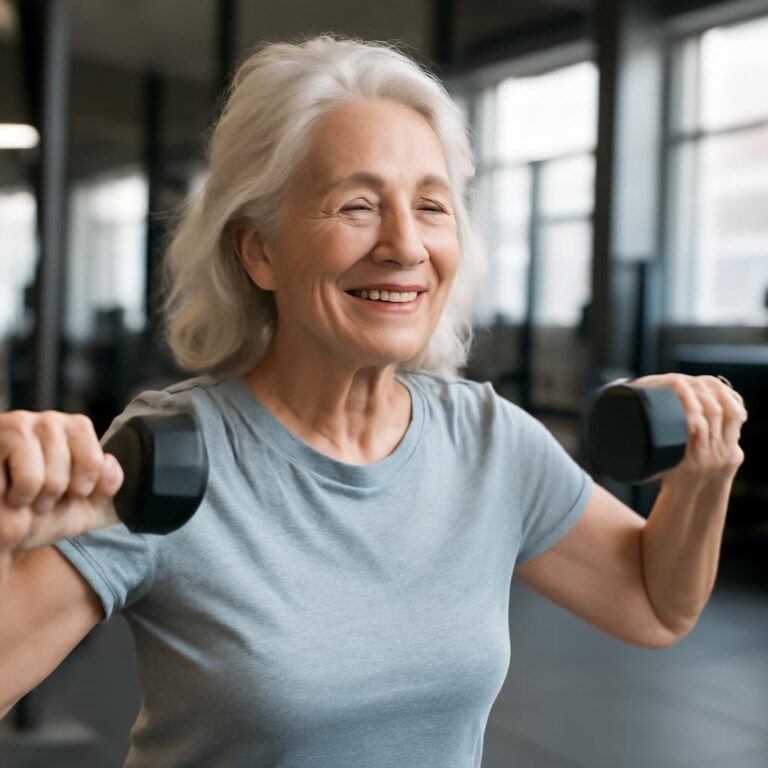
If you take away only one thing, take this. Loading the skeleton with real force is the single most evidence-backed way to build bone, and it is the one thing most people badly under-dose. Bone responds to strain. When a muscle hauls hard on a bone, or your body absorbs an impact, the bone reads that load as a message and tells the osteoblasts to reinforce the spot. A gentle walk is good for your heart and your mood, but the strain it puts through bone is too low to reliably build density. To move bone, the stimulus has to be substantial — and that word is doing a lot of work.
The cleanest evidence comes from the Australian LIFTMOR trials. Postmenopausal women with low bone mass trained just twice a week, supervised, at genuinely high intensity — heavy barbell squats, deadlifts and overhead presses pushed toward 80 to 85 percent of their maximum, plus jumping-style impact work. Over eight months that group gained density at the spine and hip while a low-intensity comparison group did not, and under proper supervision the heavy lifting proved safe even in women who started out with fragile bones. A follow-up trial in older men, LIFTMOR-M, found much the same. Two details are easy to miss and worth underlining: the active ingredient was intensity, not volume — twice a week was enough because the loads were heavy — and the training was supervised, with real attention to form. That is the model to copy.
Copying it does not mean walking into a gym and loading a bar to your limit on day one; that is how people get hurt. The path that works is patient. You learn the movement patterns with light weight and clean technique, then add load gradually over weeks and months as your body adapts. The big compound lifts — a hinge like the deadlift, a squat, an overhead press — load the hip and spine, the two sites that matter most for fracture, far better than machines that isolate one small muscle at a time. Train the pattern before the weight, always. Get coaching if you possibly can; a trainer or physical therapist who knows older adults and low bone density is worth every dollar for the first few months. And add impact carefully — heel drops, small hops, step-downs all feed bone — but if you already have osteoporosis or spinal fractures, clear anything high-impact or heavy on spinal flexion with your doctor first.
For the movements themselves and how to progress them, see our walkthroughs on the best exercises to improve bone density after 50 and strength training after 50 for bone health.
Feed the rebuild
Exercise gives bone the order to rebuild; food supplies the bricks. Skimp on protein or run short on the key minerals and your body simply cannot act on the training signal, no matter how hard you push in the gym.
Protein comes first, and it is where people over 50 most often fall short. Roughly half of bone by volume is a protein matrix, and older adults who eat too little of it lose both bone and muscle faster. Aim for something like 1.0 to 1.2 grams per kilogram of body weight a day — for a 70-kilo (154-pound) person that is around 70 to 85 grams, spread across your meals rather than dumped into one. Calcium sits close behind, at about 1,200 milligrams a day, and food should do most of the lifting: dairy, canned fish with the bones in, tofu and leafy greens come packaged with other nutrients a pill cannot replicate. Reach for a supplement only to close the gap between your plate and the target, since very high supplemental doses have not been shown to help bone more and may carry trade-offs of their own. Vitamin D is what lets you absorb that calcium in the first place, and plenty of adults over 50 run low, especially through winter; the right dose depends on your blood level, so ask for a test instead of guessing. Vitamin K2 and magnesium round out the supporting cast — both help steer calcium into bone — and both are best gathered from a varied diet of greens, nuts, legumes and fermented foods, where the evidence is stronger than it is for high-dose pills.
We go deeper on the specifics in our guides to protein and bone health and calcium and vitamin D — and what your bones need beyond them.
Stop the quiet erosion
Sometimes the fastest way to protect bone is to stop doing something that is steadily taking it. A few things do not merely slow your rebuilding — they actively speed the loss, so pulling them out can shift your whole trajectory. Smoking is near the top of that list: tobacco is directly toxic to bone-building cells and one of the strongest fracture risks you can actually change, and quitting helps at any age. Heavy drinking is another; regularly going past a moderate amount interferes with bone formation and raises your odds of a fall, so keeping intake low or moderate genuinely matters. Chronically high cortisol belongs here too — long-running stress, poor sleep and especially long courses of oral steroids all push it up, and it drives bone loss, which is why minding your sleep and stress is bone protection rather than self-care fluff.
Certain medications can chip away at bone over time as well — long-term steroids, some acid-reflux drugs, a handful of others. The important word there is certain, and the important rule is that you never stop a prescribed medication on your own. Instead, ask your doctor whether anything you take affects bone, and whether an alternative or some added protection makes sense.
When medication earns its place
This article is about the natural levers, and they are powerful. But being honest means saying plainly that for some people medication is simply the right call — and choosing it is not a personal failure or proof you did not try hard enough. It is a tool matched to a level of risk. It deserves serious consideration in a few clear situations:
- Your T-score is at or below −2.5, in the osteoporosis range, where lifestyle alone is unlikely to restore density.
- You have already had a fragility fracture — a break from a fall at standing height or less — which is a loud signal of high future risk.
- Your FRAX score, the 10-year fracture estimate your doctor can calculate, comes back high.
In those cases the goal is preventing a hip or spine fracture that could rearrange your life, and the evidence that medication cuts those fractures is strong. The smartest plan is rarely “drugs versus nature.” It is usually both at once: medication to knock down near-term fracture risk, plus the training and nutrition that build the muscle, balance and bone quality no drug delivers on its own. If you want the non-drug side in more depth, our companion pieces on how to build bone density after 50 and on reversing osteoporosis without drugs dig into the trade-offs.
A realistic first year
Sequencing matters. Spend the first month or two learning technique and correcting any vitamin D shortfall, add weight steadily to the main lifts once your form is solid, and keep the training heavy through the back half of the year, which is where bone adaptation compounds. We have mapped that out month by month in our 12-month plan for building bone density after 50. The biggest predictor of results is showing up in month eleven. If keeping it all straight on your own feels like a lot, a structured program such as The Bone Density Solution can give you a day-to-day framework to lean on, alongside your doctor’s guidance rather than in place of it. We read through it ourselves and set out what it covers and where it falls short.
How you tell whether it is working
Because bone changes slowly, a repeat DEXA sooner than about 12 to 24 months mostly measures noise, not progress. Use the same machine each time so the numbers are comparable, and read the result against that machine’s least-significant-change threshold rather than reacting to every decimal. If you and your doctor want an earlier read, bone turnover markers — blood or urine tests such as CTX, which tracks breakdown, and P1NP, which tracks formation — can show the balance shifting months before a scan would, though they are used mainly to follow a treatment response and are best interpreted by your doctor.
Do not overlook the everyday signals, either. Getting measurably stronger, steadier on your feet, more confident on the stairs — those cut your fall and fracture risk directly, and they show up within weeks to a couple of months, long before any scan moves. That gap between how fast you feel different and how slowly the numbers change is exactly why people quit too early. Strength and balance answer in weeks; density answers in a year or more. Knowing that in advance is what keeps you training through the quiet middle stretch, and it also answers the question people ask most — can you really do this without drugs? In the osteopenia range, often yes, at least enough to slow the loss and sometimes claw back a percent or three. Deep in the osteoporosis range, usually not all the way, which is where medication alongside the training becomes the wiser plan rather than a defeat. And no, supplements alone will not rebuild bone; correcting a real deficiency and hitting your protein and calcium clears the path so exercise can do the actual work, but no pill replaces the mechanical loading that tells bone to strengthen.
Sources
- Watson SL et al. High-Intensity Resistance and Impact Training (LIFTMOR trial), Journal of Bone and Mineral Research, 2018 — PubMed.
- National Institute of Arthritis and Musculoskeletal and Skin Diseases (NIAMS) — Osteoporosis.
- Bone Health & Osteoporosis Foundation (BHOF).
- NHS — Osteoporosis: overview, prevention and treatment.
- Mayo Clinic — Osteoporosis: symptoms and causes.
The Bone Density Solution
A structured program designed for adults over 50 to support bone density through diet, exercise, and lifestyle changes — an integrated approach to reducing fracture risk. Best used alongside, not instead of, professional medical care.
Check The Bone Density Solution →Affiliate link — we may earn a commission at no extra cost to you. Full disclosure.
Medical disclaimer: This article is for informational purposes only and is not medical advice. Consult your physician before changing supplements, medications or exercise routines. See our full medical disclaimer.
More in this series: rebuilding bone naturally