Osteopenia Diet and Exercise Plan: A Realistic Weekly Routine
Disclosure: We may earn a commission if you purchase through links on this page. This does not affect our editorial assessment. See our affiliate disclosure.
The moment a doctor says the word osteopenia, most people fixate on the number that came back on their bone scan. It looks like a verdict. It isn’t. Osteopenia is not osteoporosis, and it is nowhere near a sentence of inevitable fractures. All it really tells you is that your bone density has slipped below the young-adult average and landed in a grey zone — a zone where what you do next genuinely matters. And the two things that matter most are also, conveniently, the two things you control every single day: how hard you make your skeleton work, and what you feed it.
None of this happens overnight, and none of it replaces the conversation you should be having with your own doctor. But a routine you can actually keep up — week after ordinary week — is the closest thing there is to a lever on your bone health. Groups like the Bone Health & Osteoporosis Foundation and the NHS point to the same modest, worthwhile payoff: hold on to the density you have, build the strength and balance that keep you steady, and cut the odds of the fall that turns thin bone into a broken one. What follows is a realistic weekly plan built around exactly that, without the hype and without any promise it can’t keep.
Load and nutrition: the two halves that only work together
Bone is not the inert scaffolding it looks like on an X-ray. It is living tissue, constantly torn down and rebuilt, and it responds to demand. Put demand on it and it holds its ground; leave it idle and it quietly gives ground away. That demand comes from load — muscles hauling on bone, and the honest thud of weight-bearing movement — and it lands hardest where you most want it, at the hip and the spine. The same work builds the muscle and steadiness that keep you off the floor in the first place.
Load alone, though, is a builder with no bricks. Bone needs raw material to remodel: calcium and protein above all, vitamin D to put the calcium where it belongs, and a supporting cast of vitamin K and magnesium. This is why the diet and the exercise are not two separate projects. A flawless diet paired with a life spent sitting leaves bone understimulated; hard training on a calcium-poor plate leaves it undersupplied. You need both halves pulling in the same direction. If you want the wider view on lifestyle-first approaches, our guide to osteopenia treatment without drugs covers the ground around this plan.
The exercise week
A bone-friendly week rests on three legs, and none of them requires a gym membership or an hour a day. The first and most important is resistance training, twice a week — the single biggest driver of the bone-building signal. The second is weight-bearing or impact movement, once or twice a week, to keep you upright and working against gravity. The third is a few minutes of balance practice on most days, which does the unglamorous but essential job of keeping you from falling. Get those three in and you have covered what bone actually responds to.
Start with the strength work, because it earns its keep. Progressive resistance training — gradually asking your muscles to handle a little more with weights, bands, or your own bodyweight — has the best evidence behind it of anything you can do for bone. Favour compound moves that load the hips, spine, and wrists rather than fiddly isolation exercises. A short menu covers it:
- Squat or sit-to-stand — loads the hips and spine
- Hip hinge or deadlift pattern with light dumbbells or a kettlebell
- Row with bands or dumbbells, for the upper back and posture
- Overhead or chest press
- Step-ups or a supported lunge
Pick a weight you can move with clean form for eight to twelve reps, do one to three sets, and nudge the load up over the following weeks as it starts to feel easy. If you have never lifted before, a handful of sessions with a good trainer or physiotherapist is some of the best money you will spend — it buys you form and confidence at once. Our walkthrough of strength training after 50 for bone health goes deeper on technique and how to progress without overreaching.
The weight-bearing side is simpler and more forgiving. Anything that has you on your feet fighting gravity counts — a brisk walk, a flight of stairs, a dance, a hike. If your body tolerates it, higher-impact touches like a light jog, heel drops, or small jumps ramp up the stimulus. But impact has to match the person doing it. If you have a fracture history or a troublesome spine, some of those moves — and forward-bending in particular — may simply be off the table, and that is precisely the sort of thing to settle with your doctor or physio before you start rather than after. For options pitched across different ability levels, see our roundup of the best exercises to improve bone density after 50.
Then there is balance, which quietly does half the work. Preventing a fall protects bone just as surely as building it. A few minutes here and there — standing on one leg while you hold the kitchen counter, walking heel-to-toe across the room, a little tai chi — measurably lowers fall risk over time, and a bit of gentle posture work looks after the spine into the bargain. Laid out across seven days, the whole thing is far less daunting than it sounds:
| Day | Movement | Nutrition focus |
|---|---|---|
| Monday | Resistance training (full body) + balance, 30–40 min | Protein at every meal |
| Tuesday | Brisk walk (weight-bearing) + balance, 30 min | Two calcium servings |
| Wednesday | Rest or gentle mobility, 15 min | Leafy greens (vitamin K) |
| Thursday | Resistance training (full body) + balance, 30–40 min | Protein + calcium after your session |
| Friday | Weight-bearing / light impact as tolerated, 20–30 min | Oily fish (vitamin D) |
| Saturday | Longer walk, hike, or dancing, 30–60 min | Nuts & seeds (magnesium) |
| Sunday | Rest + balance practice, 10 min | Plan and prep the week ahead |
Treat that grid as a rhythm, not a rulebook. Miss a day, shuffle the order, swap a walk for a dance — it all still counts. Consistency over months is what moves the needle, and the schedule only exists to make consistency easier.
What to put on the plate
Calcium is the nutrient everyone thinks of first, and it is the foundation, but it is not the whole building. The approach that holds up is food-first: build meals that quietly supply the full set of bone nutrients, and reach for supplements only to close a gap you and your doctor have actually identified rather than one you’re guessing at.
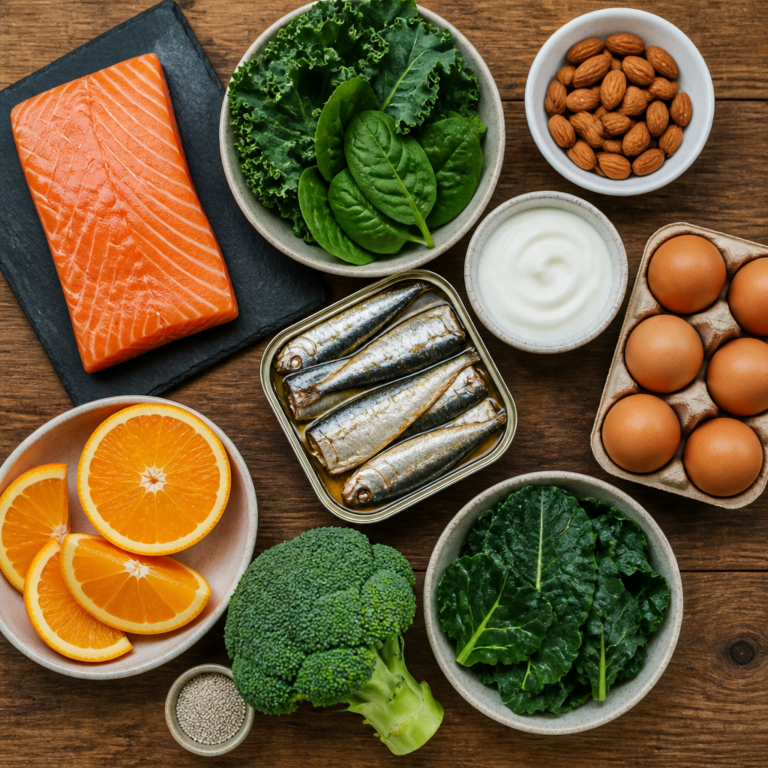
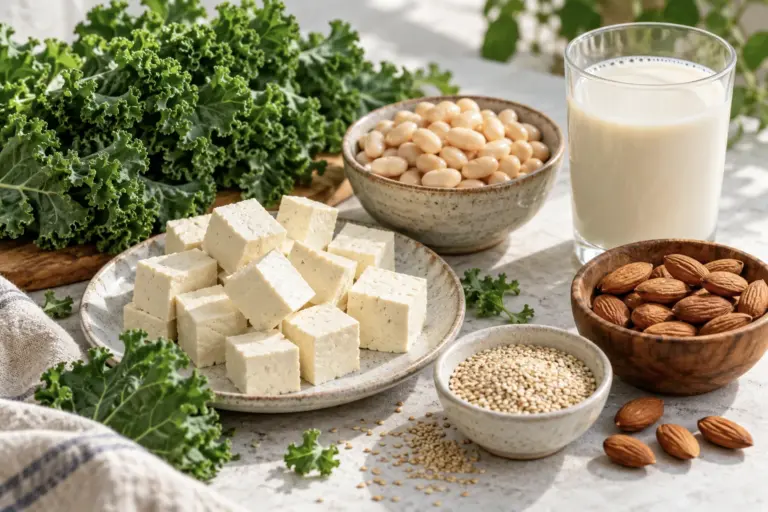
On calcium, most adults over 50 are steered toward roughly 1,200 mg a day, though the exact figure shifts with age and country, so it’s worth confirming your own target. Food beats pills here — some studies have tied heavy supplement use to unwanted side effects — and the good sources are the familiar ones: dairy such as milk, yogurt, and cheese; fortified plant milks and tofu; canned sardines and salmon eaten with their soft bones; and leafy greens like kale and bok choy. If you want specific amounts per serving to hit that number, our guide to calcium-rich foods for osteopenia lays them out.
Protein is the one older adults most often shortchange, and it matters twice over: it makes up much of the bone matrix itself, and it preserves the muscle standing between you and a fall. Aim for somewhere around 1.0 to 1.2 grams per kilogram of body weight a day, spread across your meals rather than dumped into one. For someone at 70 kg — about 154 pounds — that lands near 70 to 84 grams daily, which is more than a token yogurt at breakfast will get you to.
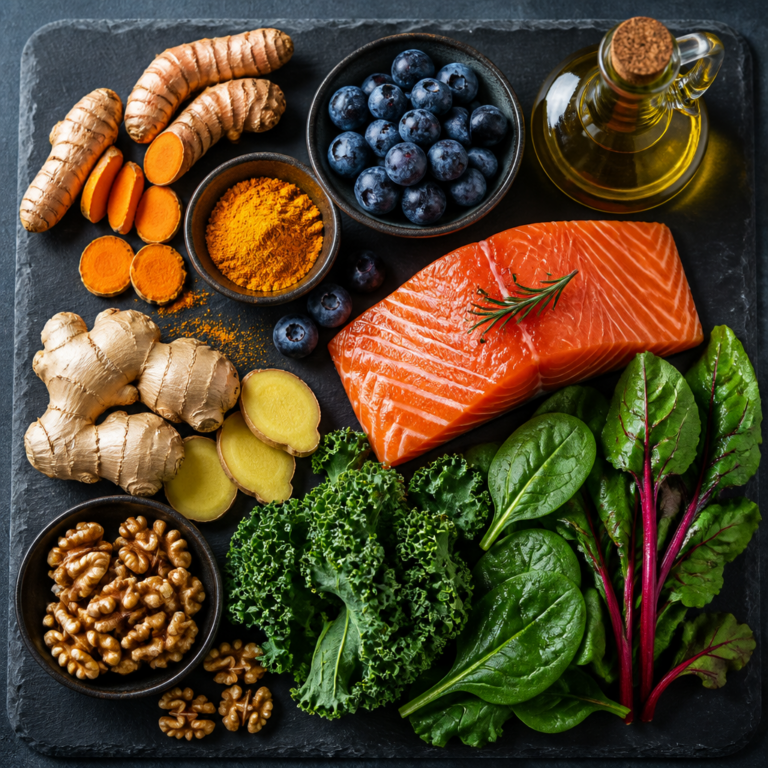
Rounding out the picture are three quieter players. Vitamin D is what lets your body absorb the calcium you eat; your skin makes it from sunlight, but plenty of older adults run low and end up needing a supplement — a very common recommendation, though one worth dosing off an actual blood test with your doctor rather than a hunch. Vitamin K, especially K2 along with the K1 in leafy greens, helps steer calcium into bone where you want it. And magnesium — found in nuts, seeds, whole grains, and legumes — plays into both bone structure and the way your body handles vitamin D. Alongside all of that, the ordinary advice still holds: keep alcohol moderate, don’t smoke, and go easy on salt and caffeine, all of which can pull in the wrong direction.
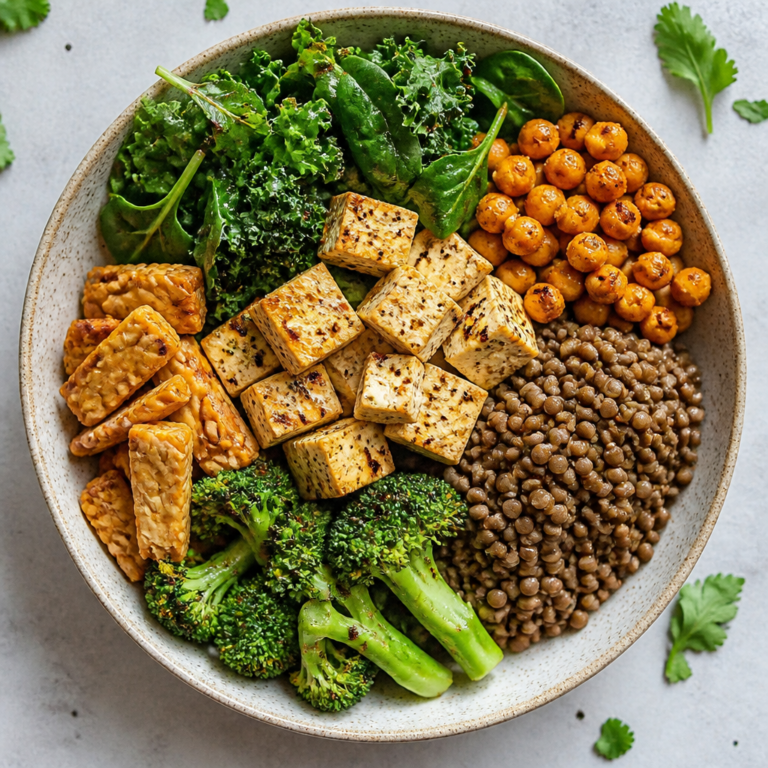
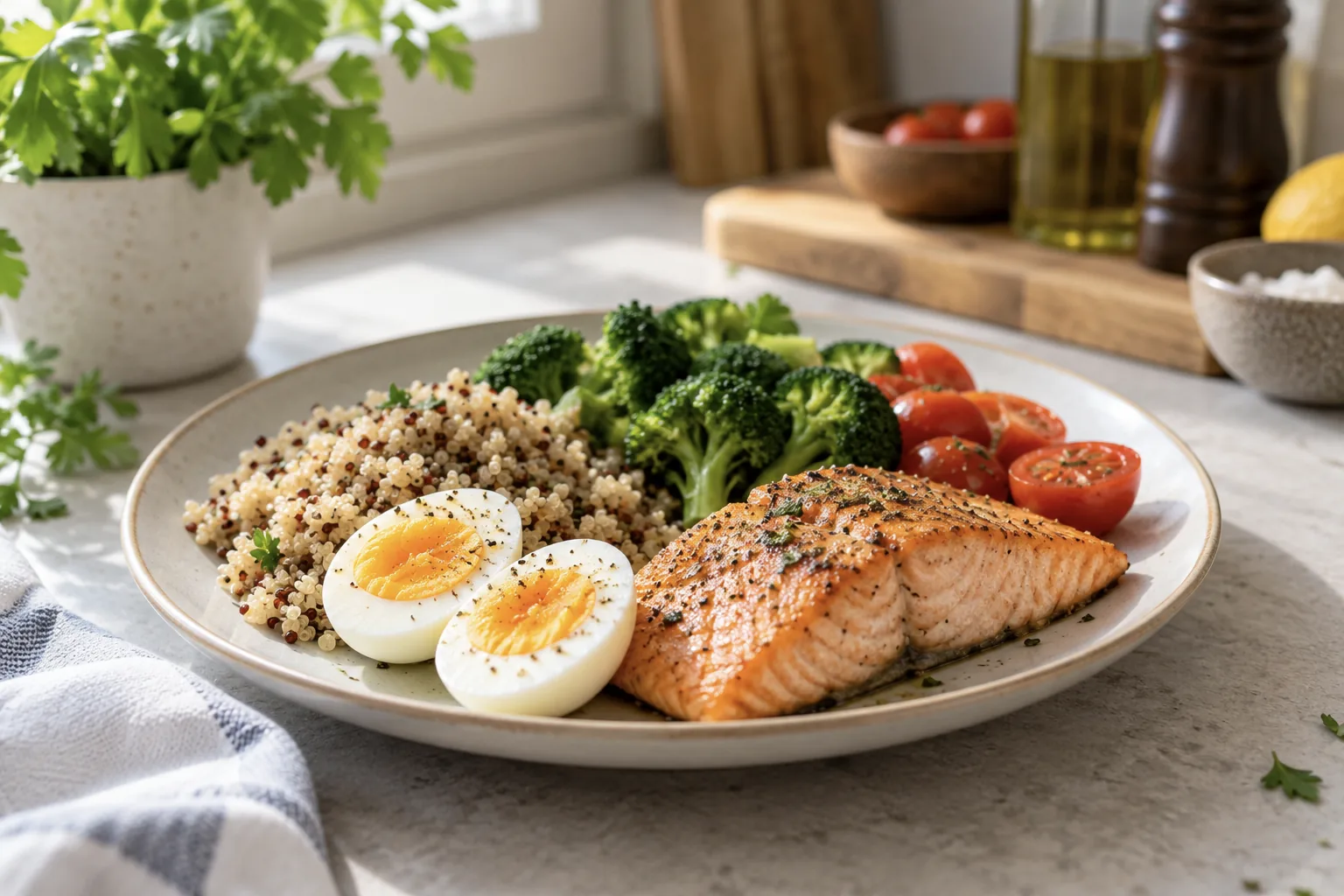
Put together, a bone-friendly day needn’t be exotic. Breakfast might be Greek yogurt with fortified oats, almonds, and berries; lunch a sardine or tofu salad over kale with chickpeas and olive oil; a mid-afternoon glass of fortified milk or a little cheese with fruit; and dinner a piece of baked salmon with broccoli or bok choy and a scoop of quinoa. That is calcium, protein, vitamin D, K, and magnesium, all arriving through the front door as food.
If you’d rather follow a ready-made structure than assemble all of this yourself, The Bone Density Solution packages the diet, movement, and lifestyle pieces into one guided program for adults over 50 — useful as a framework to lean on, provided it sits alongside your doctor’s guidance rather than in place of it. If you want to know what the programme actually asks of you week to week, we cover that in our detailed look at what it includes.
Measuring progress without losing your nerve
Bone moves slowly, which is why the scan is a poor day-to-day scoreboard — a DXA is usually repeated only every year or two, on your doctor’s schedule. Judge yourself instead by what you can feel changing. The dumbbell that felt heavy last month moves more easily. The walk stretches a little farther. You can hold a one-legged stand past the point where you used to wobble. The stairs stop announcing themselves. Those are the real signs the plan is working, and they show up long before any scan would.
A few honest cautions belong here too. Progress gradually — sudden jumps in weight or impact are how people get hurt, and sharp pain is a signal to stop rather than a hurdle to power through. If you’ve had a fracture, a diagnosis of osteoporosis, spinal trouble, or balance problems, get a plan tailored to you by a doctor or physiotherapist before you begin, because some movements, loaded forward bending and twisting chief among them, may need to be left out entirely. And keep the honest frame in view: diet and exercise support your bones, but they don’t cure osteopenia or make you fracture-proof. For some people medication is the right call — that’s a decision to reach with your doctor, sitting alongside these lifestyle steps, not instead of them.
People often ask whether all this effort can actually turn osteopenia around. The candid answer is that it can help you hold density and, for some, deliver modest gains, but there’s no guarantee of reversing bone loss — the realistic prize is slowing further loss while you build strength and steadiness. Others ask whether walking alone is enough; it’s genuinely valuable weight-bearing movement, but on its own it’s a mild signal for bone, and it’s the twice-weekly resistance work that gives your skeleton something to respond to. And if you’re weighing whether to check with a doctor first, treat that as a yes, particularly before new resistance or impact work and doubly so with any history of fractures, osteoporosis, or balance issues — a professional can shape the plan to your body and flag anything you should steer clear of.
The Bone Density Solution
A structured program designed for adults over 50 to support bone density through diet, exercise, and lifestyle changes — an integrated approach to reducing fracture risk. Best used alongside, not instead of, professional medical care.
Check The Bone Density Solution →Affiliate link — we may earn a commission at no extra cost to you. Full disclosure.
Sources
- NIAMS — Osteoporosis and bone health
- Bone Health & Osteoporosis Foundation (BHOF)
- NHS — Osteoporosis
- Mayo Clinic — Osteopenia
Medical disclaimer: This article is for informational purposes only and is not medical advice. See our full medical disclaimer.