Walking for Bone Health: How Much Do You Actually Need?
Disclosure: We may earn a commission if you purchase through links on this page. This does not affect our editorial assessment. See our affiliate disclosure.
Walking is often dismissed as “not enough” when it comes to bone health. People assume you need intense exercise — heavy weights, high-impact workouts — to make a meaningful difference. The truth is more nuanced, and for many people over 50, walking is an excellent starting point that delivers real, measurable bone benefits when done right.

Does Walking Actually Help Bones?
Yes — but the degree depends on how you walk. Walking is a weight-bearing exercise, which means your skeleton has to support your body weight with every step. This mechanical load is exactly what bone needs to maintain and build density. Bone responds to stress by becoming stronger — a principle called Wolff’s Law.
Research consistently shows that regular walkers have higher bone mineral density than sedentary adults. A study published in the American Journal of Public Health found that women who walked at least 4 hours per week had a 41% lower risk of hip fracture compared to those who walked less than 1 hour per week. That’s a substantial reduction from something most people can do without any equipment or gym membership.
Walking vs. Higher-Impact Exercise
To be fair: walking is not as potent for bone building as higher-impact activities like running, jumping, or resistance training. The mechanical stimulus it provides is relatively modest compared to these. For someone with no bone density concerns and the capacity for higher-impact exercise, walking alone may not be sufficient to significantly improve bone density.
However, for many people over 50 — particularly those with joint pain, osteopenia, balance concerns, or who are simply starting from a sedentary baseline — walking is safe, sustainable, and effective. It also supports muscle strength and balance, which reduce fall risk. And for people who are already doing resistance training, adding regular walking compounds the benefits.
How Much Walking Do You Need?
The evidence suggests a meaningful threshold around 30 minutes of brisk walking most days of the week — roughly 150 minutes per week, which aligns with general physical activity guidelines. Brisk means a pace where you can speak in short sentences but not sing — not a leisurely stroll.
Step count is another useful frame: research suggests that around 7,000–8,000 steps per day is associated with significant health benefits including bone outcomes, though more steps continue to add benefit up to around 10,000. Below 5,000 steps per day is generally considered sedentary.
Frequency and consistency matter more than duration on any single day. Five 30-minute walks per week does more for bones than one long 2.5-hour walk.
How to Make Walking More Effective for Bone Health
Walk on varied terrain
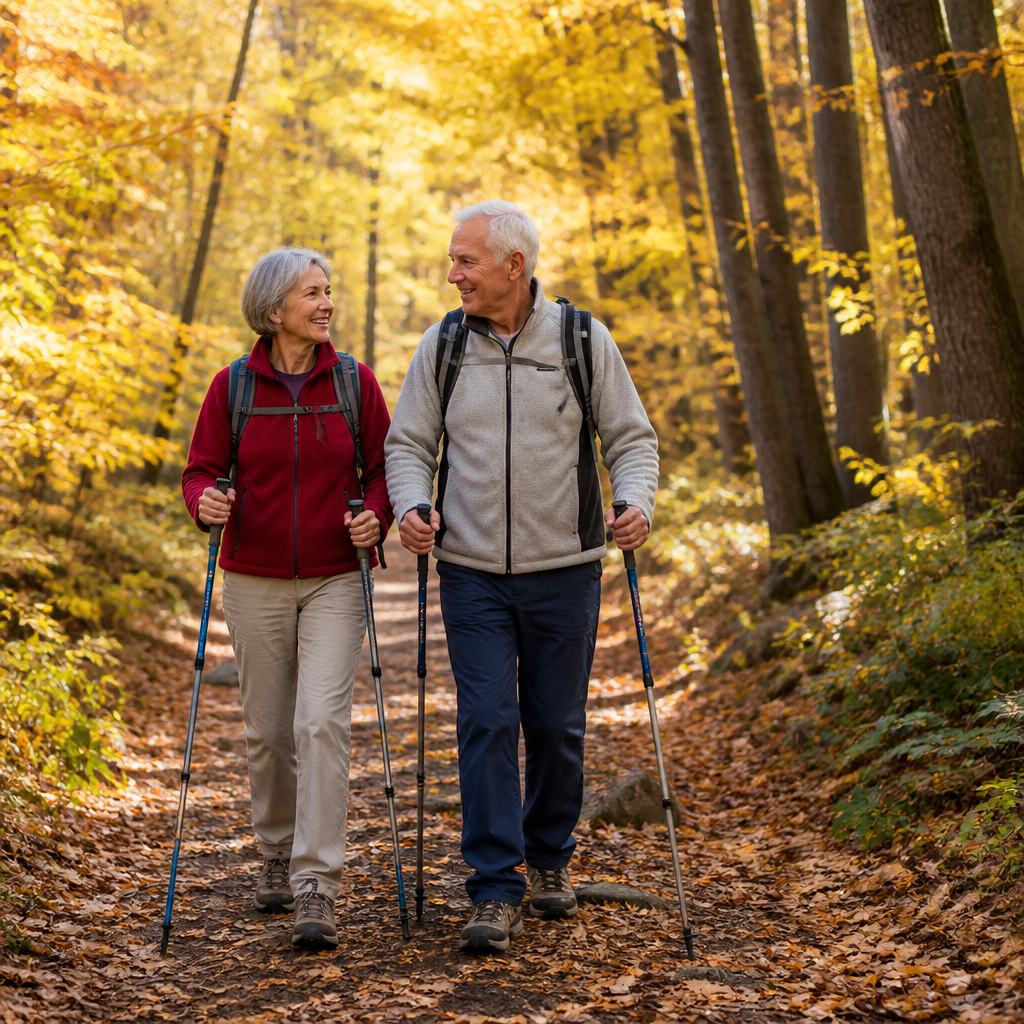
Flat pavement provides a consistent, low stimulus. Walking on hills, uneven paths, grass, or gravel increases the mechanical demand on your bones and muscles — and challenges your balance in ways that flat surfaces don’t. If you can access parks, trails, or even hilly streets, use them.
Increase your pace
Brisk walking generates more ground reaction force than a slow stroll — meaning more stimulus for bone. If you currently walk slowly, gradually increasing your pace over weeks adds meaningful benefit without added joint stress.
Add intervals
Brief bursts of faster walking or even short jogging intervals (if appropriate for your fitness level and joint health) significantly increase the bone stimulus. Even 10–20 seconds of faster movement repeated several times during a walk changes the mechanical profile substantially.
Walk with a weighted vest
A weighted vest adds load to the skeleton during walking, amplifying the bone stimulus without increasing joint impact the way running does. Research has found that postmenopausal women who walked with a weighted vest showed greater improvements in hip bone density than those who walked without one. Start with a light vest (5–10% of body weight) and increase gradually.
Add strength training alongside
Walking and resistance training work synergistically. Walking primarily loads the hips and spine through compression; resistance training targets specific muscle groups that pull on bones and stimulate remodeling in ways walking doesn’t. The combination is more effective than either alone for both bone density and fall prevention.
Walking for Fall Prevention
Beyond bone density, regular walking significantly improves the factors that determine whether a fall turns into a fracture: muscle strength, balance, coordination, and reaction time. Hip fractures — the most serious consequence of osteoporosis — result from falls in the vast majority of cases. Building the habit of daily walking is one of the most practical investments you can make in fracture prevention, even when bone density improvements are modest.
Getting Started
If you’re currently sedentary, start with 10–15 minutes per day and build up by 5 minutes each week. Consistency over weeks and months matters far more than any single session. Comfortable, supportive footwear is important — worn-out shoes reduce both cushioning and stability.
For a complete approach that combines walking with targeted nutrition and other exercise strategies designed to maximize bone density improvements, The Bone Density Solution offers a structured daily program built specifically for adults over 50.
Walking alone may not rebuild bone dramatically — but done consistently, at the right intensity, and combined with smart nutrition, it is a genuinely valuable part of a bone health strategy. And it costs nothing.
Related articles:
7 Best Exercises to Improve Bone Density After 50
Osteoporosis Prevention: Habits That Make a Difference
Warning Signs of Low Bone Density You Shouldn’t Ignore
Related Articles
Who Should Be Careful When Starting a Walking Programme
Walking is one of the safest forms of weight-bearing exercise, but a few groups should take extra care:
- Those with recent lower limb fractures or foot and ankle injuries
- People with balance issues or a history of falls — consider walking with a companion or using a walking aid if needed
- Anyone with cardiovascular conditions should speak with their doctor about appropriate pace and duration
- Those with severe joint pain who find walking aggravates symptoms
If you are just starting out, even short walks (10–15 minutes) are beneficial and can be gradually extended. There is no need to rush progression.
Sources and Further Reading
This article is for educational purposes only and does not replace advice from a qualified healthcare professional.
The Bone Density Solution
A structured program specifically designed for adults over 50 to improve bone density through diet, exercise, and lifestyle changes. Takes an integrated approach to reducing fracture risk.
Check The Bone Density Solution →Affiliate link — we may earn a commission at no extra cost to you. Full disclosure.
Disclosure: This article contains affiliate links. We may earn a small commission if you purchase through our links, at no extra cost to you.
Medical disclaimer: This article is for informational purposes only and is not medical advice. Consult your physician before changing supplements, medications or exercise routines, especially if you have been diagnosed with osteopenia or osteoporosis. See our full medical disclaimer.