
Low Testosterone and Bone Loss in Men: What TRT Does and Doesn’t Fix
Disclosure: We may earn a commission if you purchase through links on this page. This does not affect our editorial assessment. See our affiliate disclosure.
You feel flat, you sleep badly, the gym is harder than it used to be, and an ad tells you the reason is your testosterone. Almost as an afterthought, the pitch adds that testosterone protects your bones too. That part is not a lie. Testosterone genuinely matters to the male skeleton, and men with truly low levels do lose bone faster than they should. But there is a wide gap between “helps your bone density” and “will keep you from breaking a hip,” and the marketing rarely walks you across it. Here is what the hormone does to bone, and what replacement has and hasn’t been shown to do.
If you are new to this, our overview of osteoporosis in men over 50 is the foundation the rest sits on.
What testosterone actually does to a man’s bones
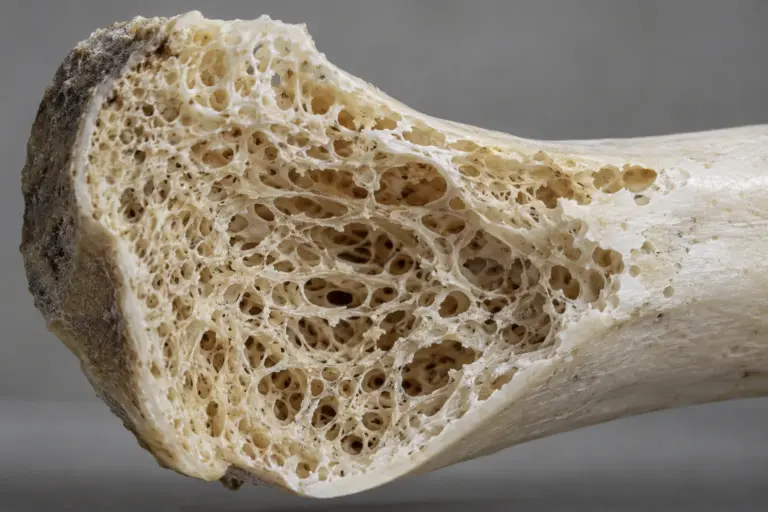
Bone is torn down and rebuilt continuously, and hormones are much of what keeps that balance. Testosterone plays two roles. Some of its effect is direct, acting on androgen receptors in bone and helping build the wide outer shell that gives the male skeleton its size advantage.
The second role surprises most men, and it is arguably the bigger one. An enzyme called aromatase converts part of your testosterone into estradiol, a form of estrogen, and that estradiol appears to be the main brake on bone breakdown in men. The evidence comes from an unusual place: rare men born without working aromatase, or with a mutation in the estrogen receptor, who have plenty of testosterone but almost no estrogen activity. They end up with low bone mass, high bone turnover, and growth plates that never closed — and giving the aromatase-deficient men estrogen improves their bone density.
So your bones care about testosterone partly for its own sake and substantially because it is the raw material your body turns into estrogen — the same hormone doing the same protective job it does in women, arriving by a different route. That is why our piece on estrogen and bone loss is worth your time even as a man. Below a certain estradiol level, bone loss and fracture risk climb, part of why two men with identical testosterone numbers can have very different skeletons.
Low testosterone, or just an older man’s testosterone?
This distinction is where a great deal of money changes hands. Genuine hypogonadism is a medical condition: the testicles or the pituitary gland are not doing their job, and the result is consistently low testosterone alongside real symptoms. It can follow injury or infection affecting the testicles, a pituitary problem, certain genetic conditions, or long-term opioid or steroid use. Diagnosing it takes more than one blood draw: at least two morning measurements on separate days, taken when you are not acutely ill, plus tests showing where it comes from.
What happens to most men over 50 is different. Testosterone drifts down slowly with age, and faster in men carrying extra weight, drinking heavily, sleeping badly, or living with poorly controlled diabetes. A number that has slipped modestly below a lab’s young-adult range is not automatically a disease, and treating it as one is the confusion testosterone clinics are built on.
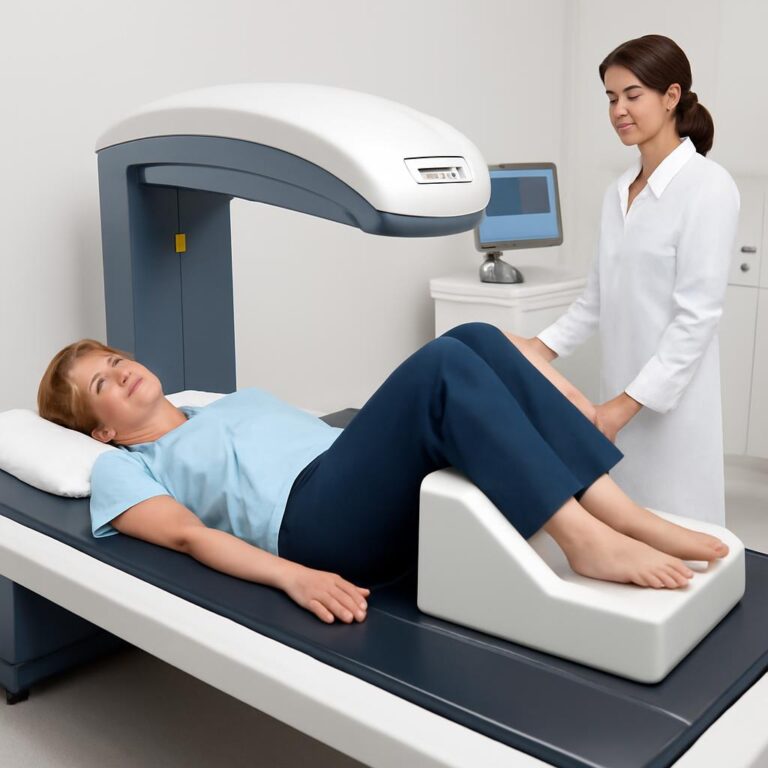
A confirmed diagnosis, on the other hand, is a legitimate reason to have your bone density measured. Our guide to the DEXA scan for men covers what the appointment involves.
Androgen deprivation therapy: when the bone loss is fast and certain
There is one situation where low testosterone is unambiguously driving bone loss. Androgen deprivation therapy for prostate cancer shuts testosterone down deliberately, and the skeleton responds accordingly. Where a healthy older man might lose roughly half a percent to one percent of bone density a year, men on androgen deprivation lose several times that — published figures run to two to five percent a year at the lumbar spine and up to around four percent at the hip. The steepest losses come early, often in the first six to twelve months.
That is not an argument against the treatment. It exists because it works against a serious cancer, and that comes first. It is an argument for making bone health part of the plan from the start rather than an afterthought three years in: a baseline bone density scan, a fracture risk assessment, attention to calcium and vitamin D, and repeat scans on your oncologist’s schedule. Some men will need a bone-protecting medication alongside the cancer treatment. If nobody has mentioned your bones, raise it at your next appointment.
What testosterone treatment has actually been shown to do to bone
The best-known study is the bone portion of the Testosterone Trials, published in 2017. Researchers took 211 men with an average age of about 72 whose testosterone was consistently low, gave half of them testosterone and half a placebo for a year, and measured bone with quantitative CT, which shows the spongy inner bone separately from the dense outer shell. The result was clearly positive: spine trabecular bone density rose about 7.5 percent in the treated men versus about 0.8 percent on placebo, and estimated bone strength at the spine rose too. Gains at the hip were much smaller.
That is a genuine effect, and bone density is fairly called one of the more legitimate claims made for testosterone. But read what the researchers wrote. There were six fractures in each group over that year, which tells you nothing. The trial was never sized to answer the fracture question, and the authors said plainly that only a larger and longer trial could determine whether testosterone reduces fracture risk.
That trial has since happened. A prespecified fracture analysis within the TRAVERSE trial followed 5,204 men aged 45 to 80 with hypogonadism and existing cardiovascular disease or risk factors for a median of about 3.2 years. It did not find fewer fractures in the testosterone group. It found more: roughly 3.5 percent of treated men had a clinical fracture compared with about 2.5 percent on placebo, a hazard ratio of 1.43. The result surprised the investigators, most of those fractures followed a fall, and nobody yet has a confident explanation. It may not be the final word, but it is the largest and longest look anyone has taken at testosterone and fractures, and it does not support the idea that testosterone is a fracture-prevention drug.
“Raises bone density” and “prevents fractures” are two different sentences. Density is a measurement; a fracture is an event, and it is the event that changes your life. Every drug we rely on for fracture prevention had to prove itself on the second sentence.
The risks, and the monitoring testosterone therapy requires
Testosterone therapy is a long-term prescription, not a supplement, and it comes with obligations. It can thicken the blood to a degree that needs watching, worsen sleep apnea, and cause fluid retention. It commonly shrinks the testicles and suppresses sperm production, which matters enormously if fatherhood is still on your list. Because it stimulates prostate tissue, men are assessed for prostate risk beforehand and monitored afterward, and it is not appropriate for a man with known or suspected prostate cancer.
Proper care means blood work before you start and repeatedly afterward, prostate monitoring on your doctor’s schedule, and a periodic review of whether the treatment is earning its place. A clinic that prescribes after one blood test and a questionnaire is not offering you that. Decide this with a doctor who will still be looking after you in two years, and never adjust or stop a prescription on your own.
When fractures are the worry, testosterone isn’t the tool
If your real concern is breaking a bone, measure the problem and then treat it: a bone density scan, plus a fracture risk estimate that folds in your age and history. Our explainer on the FRAX score covers why that calculation often matters more than the density number alone.
When treatment is warranted, the options with proven fracture reduction in trials are osteoporosis drugs, and they work in men as well as women. We compare the main families in osteoporosis medications compared. A man can be treated for low testosterone and for osteoporosis at once if both are genuinely present. What should not happen is testosterone being offered as a substitute for the treatment shown to prevent the thing you are afraid of.
What helps that isn’t a prescription, and what to ask your doctor
Bone responds to load, and no hormone substitutes for that signal. Progressive resistance training is the strongest lever you have, and heavier, well-coached lifting does more for bone than light circuits, the case we lay out in strength training after 50. Add balance work too, because most fractures in men over 50 happen because somebody fell, and not falling is a skill you can train.
The rest is unglamorous and genuinely matters. Enough protein across the day supports muscle and the collagen framework of bone, as we cover in protein and bone health. Vitamin D status is worth checking rather than guessing at, and our article on vitamin D for bone health after 50 explains the reasoning. Heavy drinking is bad for bone and for balance, and poor sleep undermines hormones and recovery alike. Being significantly underweight is a real fracture risk in men, so aggressive weight loss in your sixties is not the free win it looks like. If you want a structured way to organize the diet-and-movement side, The Bone Density Solution is one we have looked at in detail (based on the materials we have seen), and you can look at the program here. Treat it as support alongside your medical care, never as a replacement for it.
A few questions will get you further with your doctor than any amount of reading:
- Do I actually have hypogonadism, confirmed on more than one morning blood test, and do we know why?
- Given my age, history, and the medications I take, should I have a bone density scan now?
- If my bone density is low, what is my estimated fracture risk, and does it warrant treatment in its own right?
- If I start testosterone, what exactly will you monitor, how often, and what would make us stop?
Testosterone is a real hormone doing real work in your skeleton, and there are men for whom replacing it is the right call. It is simply not the bone drug the advertising implies, and knowing the difference is what lets you say yes or no for the right reasons.
The Bone Density Solution
A structured program designed for adults over 50 to support bone density through diet, exercise, and lifestyle changes — an integrated approach to reducing fracture risk. Best used alongside, not instead of, professional medical care.
Check The Bone Density Solution →Affiliate link — we may earn a commission at no extra cost to you. Full disclosure.
Sources
- PubMed — the Testosterone Trials bone sub-study on volumetric bone density and strength in older men with low testosterone
- New England Journal of Medicine — the TRAVERSE prespecified analysis of testosterone treatment and clinical fractures
- Endocrine Society — clinical practice guideline on testosterone therapy in men with hypogonadism, covering diagnosis and monitoring
- NIAMS — osteoporosis in men, including risk factors, diagnosis and treatment
- Mayo Clinic — male hypogonadism, its causes, symptoms and complications
- Bone Health & Osteoporosis Foundation — general facts on bone loss, fracture prevention and who should be tested
Medical disclaimer: This article is for informational purposes only and is not medical advice. See our full medical disclaimer.