Does Dairy Weaken Bones? What Large Studies Actually Show
Short answer: the research does not show that milk protects against fractures, and it does not show that dairy reliably weakens bones either. Large studies mostly find no clear fracture benefit from drinking more milk. One big Swedish study found a small signal of harm in women that its authors urge caution about. Dairy is one useful source of calcium, not a requirement and not a poison.
Why the question exists
Two opposite claims circulate. Dairy marketing says milk builds strong bones. Some health books say dairy is inflammatory and “leaches” calcium. Both are simpler than the research. Here is what the main studies found.
Three studies that matter
The Nurses’ Health Study (Feskanich 1997)
This 12-year study followed 77,761 women aged 34 to 59 who did not use calcium supplements. The authors found no evidence that higher milk or food-calcium intake reduced fractures. Women drinking two or more glasses a day had a hip fracture relative risk of 1.45, but the confidence interval (0.87 to 2.43) included no difference, and the forearm fracture risk was essentially unchanged (1.05).
A meta-analysis of prospective cohorts (Bischoff-Ferrari 2011)
Combining prospective studies, the analysis found no overall association between milk intake and hip fracture in women (six studies, 195,102 women, 3,574 hip fractures; relative risk 0.99 per daily glass, 95% CI 0.96 to 1.02). In men the pooled relative risk per glass was 0.91 (0.81 to 1.01), based on only 195 hip fractures, and the authors said more data are needed.
Two Swedish cohorts (Michaëlsson 2014)
This study followed 61,433 women for about 20 years and 45,339 men for about 11 years. In women, drinking three or more glasses a day was linked to higher mortality (hazard ratio 1.93 compared with under one glass), and each extra glass was linked to a slightly higher hip fracture risk (1.09, 1.05 to 1.13). In men, fracture risk did not change with milk. The authors recommended cautious interpretation because observational studies can be confounded and can reflect reverse causation, for example people with poor health changing what they drink.
Calcium itself: does the source matter?
A 2015 meta-analysis of 59 trials in people over 50 found that raising calcium intake, from food or from supplements, increases bone density by small amounts (about 0.6 to 1.8%) that do not keep growing and are unlikely to cut fractures by much (Tai 2015). Dairy is a convenient and well-absorbed source of calcium, but the studies above suggest that drinking more of it does not buy extra protection once you are meeting your needs.
What about claims that dairy cancels out its own calcium?
Some books point to A1 beta-casein or to the cells in milk. The study usually cited for A1 beta-casein (Laugesen and Elliott 2003) correlated A1 milk supply with heart disease and type 1 diabetes across countries. It is not about bone, and it is an ecological correlation, not a trial. We found no fracture study among the ones above that supports the idea that dairy calcium is useless.
What to do
- If you enjoy dairy and tolerate it, one or two servings a day is a reasonable way to reach about 1,200 mg of calcium, alongside other foods.
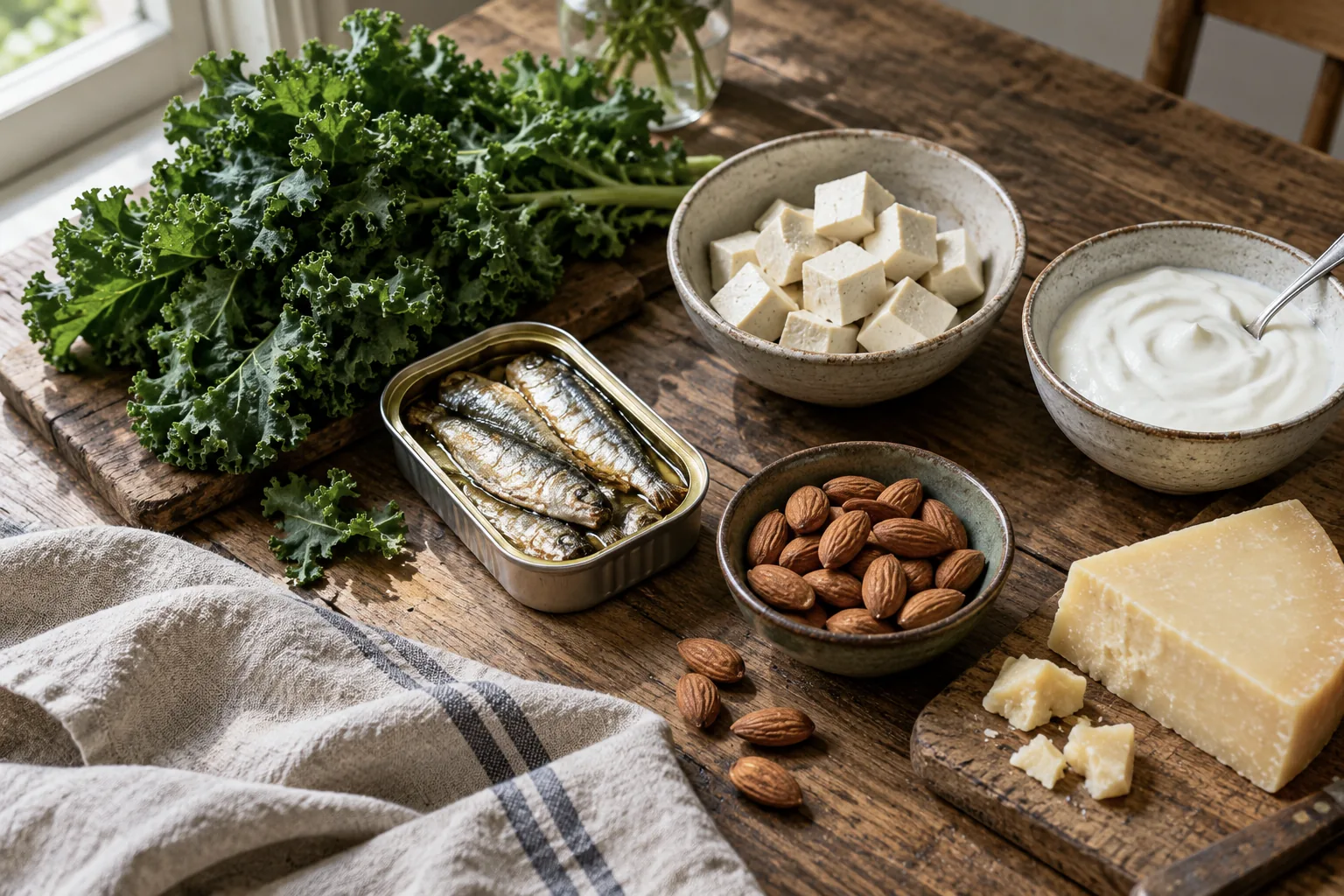
- If you avoid dairy, you can get there with fortified foods, canned fish with bones, tofu set with calcium and low-oxalate greens. See dairy-free calcium sources, lactose intolerance and bone density and calcium-rich foods.
- Do not stop at calcium. Protein, vitamin D, loading exercise and falls prevention matter at least as much. Our review of one popular book’s claims shows how dairy fears get overstated.
References
- Feskanich D, et al. Milk, dietary calcium, and bone fractures in women: a 12-year prospective study. Am J Public Health 1997;87:992-7. PubMed
- Bischoff-Ferrari HA, et al. Milk intake and risk of hip fracture in men and women: a meta-analysis of prospective cohort studies. J Bone Miner Res 2011;26:833-9. PubMed
- Michaëlsson K, et al. Milk intake and risk of mortality and fractures in women and men: cohort studies. BMJ 2014;349:g6015. PubMed
- Tai V, et al. Calcium intake and bone mineral density: systematic review and meta-analysis. BMJ 2015;351:h4183. PubMed
- Laugesen M, Elliott R. Ischaemic heart disease, type 1 diabetes, and cow milk A1 beta-casein. N Z Med J 2003;116:U295. PubMed
This article contains no affiliate links. See our medical disclaimer and editorial policy.