Osteoboost Review: Does It Work? Cost, Safety and the Trial Data
- What it is: a prescription wearable vibration belt that the manufacturer says the FDA authorised (De Novo pathway) for postmenopausal women with osteopenia, a DXA T-score between -1.0 and -2.49.
- Evidence: in a 12-month sham-controlled trial the all-participants comparison on the primary outcome was not statistically significant; women who used it at least three times a week lost less vertebral strength and density than the sham group. Fractures were not measured.
- Cost (October 2026): the company lists a $995 self-pay launch price ($1,500 list) and says insurance and Medicare do not cover it. Prices change, so check the current price.
- Safety: no serious device-related adverse events were reported in the trial; the labelling lists reasons to stop and call your doctor.
- Not the target group: men and people with osteoporosis are outside what it was studied in.
See current price and refund terms →
What Osteoboost is
Osteoboost is a belt-style device worn around the hips and lower back. It contains a small vibration motor and is sold by Osteoboost Health, Inc.; its developer is Bone Health Technologies, whose staff are among the trial authors. According to the manufacturer’s published information, it delivers targeted vibration to the lumbar spine and hips, and you wear it over a thin layer of clothing for about 30 minutes a day while you do light activity such as walking or household chores.
The idea is mechanical: bone responds to the forces placed on it, and the company’s pitch is that calibrated vibration gives bone a small, repeated signal without jumping or lifting. That is a plausible hypothesis, which is why the trial below matters.
What the FDA clearance does and does not mean
The manufacturer states that Osteoboost is “the first FDA-cleared drug-free prescription treatment for osteopenia in postmenopausal women” and that it was authorised through the FDA’s De Novo pathway, a route for new kinds of lower-risk devices that have no earlier equivalent to compare against. We could not open the FDA’s own decision record while writing this, so the regulatory details here come from the manufacturer’s pages and trade press, not from the agency’s database. If the exact wording matters to you, ask your doctor to check the current labelling.
The company’s published Indications for Use give the precise scope. Osteoboost is described as “indicated to reduce the decline in bone strength and volumetric bone density” in postmenopausal women with osteopenia of the lumbar vertebrae or total hip. Three details in that wording are easy to miss:
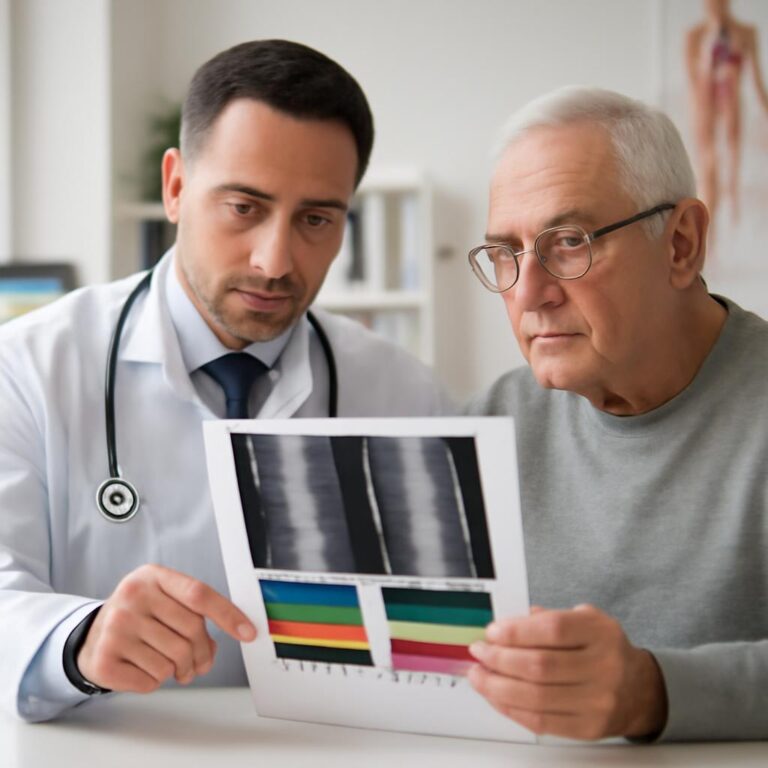
- The indication is about slowing a decline in bone strength and density, as assessed on CT scans analysed with specialised software. It is not worded as preventing fractures or restoring bone.
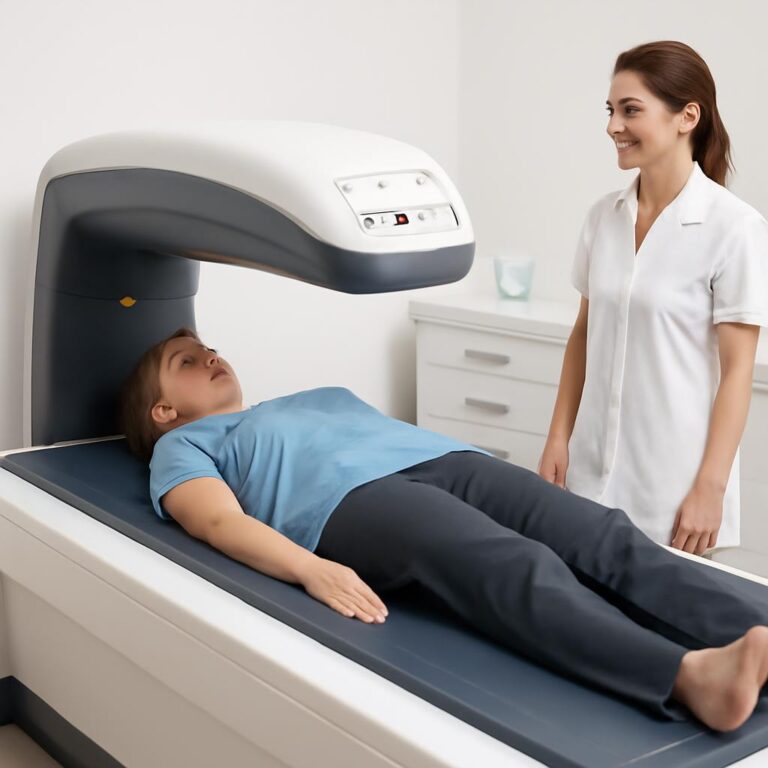
- The population is postmenopausal women with osteopenia, defined by the company as a DXA T-score between -1.0 and -2.49.
- Authorisation is not the same as proven fracture prevention. A De Novo decision tells you the FDA judged the benefits and risks acceptable for the stated use. It does not tell you the device lowers your chance of breaking a bone.
Who it is for (and who it is not)
Based on the manufacturer’s published information:
| Group | What the manufacturer says |
|---|---|
| Postmenopausal women with osteopenia | This is the indicated population. |
| Men | Not the indicated group. The company’s FAQ says it “has not been studied in men” and mentions a planned trial. |
| People with osteoporosis | The labelling says it has not been studied in people with osteoporosis. |
| Women at high risk of bone fragility, many non-Caucasian women, BMI above 35 | Safety and effectiveness have not been established. |
| Spinal fusion, herniated disc treatment, joint replacement in ankle/knee/hip, active implant near spine or pelvis, neoprene allergy | Labelling says to tell your doctor before using it. |
The trial excluded people with conditions such as recent fractures, cancer and type 1 diabetes, and those taking medicines that affect bone, so its results describe generally healthy postmenopausal women with mildly reduced density, mean age about 61.
If you have been told you have osteoporosis rather than osteopenia, or you have had a fragility fracture, this device is outside what it was studied for. That is a conversation for your own doctor, who will also tell you where your numbers sit. Our guides to T-scores and Z-scores and to how often to have a DXA scan explain what the categories mean.
How you use it
The manufacturer recommends about 30 minutes a day, worn snugly over a thin layer of clothing while standing, walking or doing light chores. Its FAQ advises against jogging, jumping and sitting or lying down during a session. In the trial, completers averaged 4.1 sessions a week (company figure). The company says changes take “at least a year” to show on a scan, and recommends a baseline CT or DXA scan and a follow-up on the same machine.
See current price and refund terms →
What the clinical trial found
The main published evidence is a randomised, sham-controlled trial reported in JBMR Plus in July 2024 (Bilek and colleagues, DOI 10.1093/jbmrpl/ziae104). The sham device made sound but gave no vibration, and all participants also took daily calcium and vitamin D. The design is the strongest kind available for a device, and it is the reason the product sits above most wellness gadgets in credibility.
| Item | What was reported |
|---|---|
| Design | Randomised 1:1, sham-controlled, 12 months, 126 women randomised (company page: 64 active, 62 sham; mean age 61.4, range 52 to 82) |
| Dose | 30 minutes a day |
| Primary outcome | Percentage change in estimated compressive strength of the first lumbar vertebra (L1), calculated from CT scans by finite-element modelling |
| All participants analysed (modified intention-to-treat) | Active -1.40% vs sham -2.74% strength change; difference +1.33% (95% CI -0.57 to 3.24), P = .17. Not statistically significant. |
| Pre-specified higher-use group (average at least 3 sessions a week; n = 73) | L1 strength: active -0.48% vs sham -2.84% (P = .028). L1 volumetric bone density: active -0.29% vs sham -1.97% (P = .016). |
| Safety | Described as well tolerated, with no serious device-related adverse events reported |
Notice the direction of every number: they are losses. Both groups, on average, lost a little bone strength over the year; the question was whether the device group lost less. In the group that used it at least three times a week, the reported difference was roughly 2.4 percentage points of vertebral strength and about 1.7 points of vertebral density.
Marketing figures such as “85% less loss of spine bone density” are relative reductions in loss, quoted by the company for the at-least-three-times-a-week group. They describe the same data as the table in a way that sounds larger; the company’s hip figure (55%) we could not check against a full-text table.
What the evidence does not show
This is the section to read if you are deciding whether to spend roughly a thousand dollars.
- The all-participants result was not statistically significant. The positive findings are from a subgroup defined by how much people used the device. Subgroups defined by behaviour after randomisation can be affected by differences between people who stick with a routine and those who do not, which is why many statisticians treat them as supportive rather than conclusive. The authors did pre-specify the threshold, which helps, but it remains a secondary lens.
- No fracture data. The primary outcome was estimated vertebral strength, a modelled measure. The trial was not designed to show fewer broken bones, and the device’s labelled use does not claim that.
- One trial, one year, with company links. Several authors are affiliated with or have received support from the developer, Bone Health Technologies; that is common for device trials but worth knowing. We could not confirm the funding statement from the pages we could read.
- The paper has been publicly questioned. A 2025 letter to the editor in the same journal argued that neither primary bone outcome differed between groups at one year, that the benefit appeared only in the highly compliant subgroup, and that a focal treatment is hard to justify for what the letter writers call a systemic disease. The authors published a response. Reading both is a good way to see where reasonable experts disagree.
- Narrow population. Mostly women in their early 60s with osteopenia, excluding many conditions and medicines. Results may not carry over to older women, to women with osteoporosis or to people taking bone drugs.
- No head-to-head comparison. There is no published comparison with exercise programmes, with prescription bone medicines or with combined approaches.
None of that means the device does nothing. It means the honest summary is “a promising, FDA-authorised device with a modest, subgroup-dependent signal on a modelled bone-strength measure” rather than “proven to rebuild bone”. Independent reviewers will weigh that differently, and so might you and your doctor.
Osteoboost cost, prescription and insurance
Prices change, so check the manufacturer’s current page. At the time of writing (October 2026), the company’s product page lists the following:
| Item | What the manufacturer states |
|---|---|
| Price | $995 “special self-pay launch price”; list price (MSRP) $1,500; one-time device purchase, not a subscription |
| Financing | Offered at checkout through a third-party lender, shown as low as $63 a month (terms and approval vary) |
| Prescription | Required. The device does not ship without one. A $30 telehealth prescription option is offered through a partner; whether you qualify is a clinician’s decision. |
| Insurance | Not covered by insurance or Medicare, according to the company |
| HSA/FSA | Reimbursement available with proof of prescription, per the company; check your plan |
| Returns and warranty | 30-day money-back policy and a one-year limited warranty, per the company |
Add the cost of the baseline and follow-up scans the company recommends. Whether the price is good value depends on how much weight you put on the trial results above.
Side effects and safety
The trial reported no serious device-related adverse events, and the company states that it has no contraindications while advising you to discuss questions with your clinician. The published labelling is more detailed about what to watch for:
- Stop using it and tell your doctor if vibration causes pain, tenderness, bruising, dizziness, headache, or a skin reaction.
- Talk to your doctor about back, leg or pelvic pain during or after use. The company’s trial page notes such complaints occurred in both the real and sham groups.
- Temporary muscle weakness, gastrointestinal upset, dizziness, loss of balance, blurred vision or headaches are also listed as reasons to stop and call your doctor.
- Do not wear it directly on skin, do not immerse it, and stop using it if it is damaged. The cover can become warm during use.
Anyone with a spinal implant, a recent spinal procedure, a hip, knee or ankle replacement, or a herniated disc being treated should get medical advice before even ordering. The company’s labelling says the same.
How to read Osteoboost reviews online
We did not collect or quote customer reviews, so we cannot summarise what “users say”. When reading them, remember that bone changes over a year or more, so an early review cannot show a bone effect; comfort and convenience are reportable, bone results are not something anyone can feel; and testimonials on a manufacturer’s own site are selected by the manufacturer.
Where The Bone Density Solution fits (a different approach)
This site is about bone health after 50, and The Bone Density Solution is the one guide we promote as an affiliate (we earn a commission; we did not write or publish it). It is a completely different kind of product from Osteoboost, so it is not a substitute and we are not claiming it does the same job.
It is a digital guide by Shelly Manning (Blue Heron Health News), delivered as a PDF and built around food, gut health, daily habits and an exercise routine. It costs a single payment of about $49 at the time of writing (check the current price), with a 60-day refund through ClickBank: no device, prescription or subscription. Its author is not a physician, there is no clinical trial of the branded programme, results vary, and it should never replace a DXA scan, your doctor or prescribed medicine. Its chapter on prescription drugs is sceptical in tone, which we do not endorse; keep your doctor in charge of any medicine.
Who might prefer which? Someone who is postmenopausal, has osteopenia, is comfortable with a roughly $1,000 purchase and wants a device with a published trial may reasonably look at Osteoboost with their doctor. Someone who mainly wants general guidance on food, exercise and daily habits, alongside the plan their doctor has set, may prefer a low-cost guide. A guide is not a treatment for osteopenia or osteoporosis, and it is not a substitute for anything your doctor prescribes. Many people could sensibly do both, with their doctor’s agreement. Our three-way comparison sets them side by side.
See current price and refund terms →
Frequently asked questions
Does Osteoboost work?
In its sham-controlled trial, the all-participants comparison on the primary outcome was not statistically significant, while women who used it at least three times a week lost less vertebral strength and density than the sham group. That is encouraging but limited, and fracture outcomes were not measured.
Is Osteoboost FDA approved?
The manufacturer says it was authorised through the FDA’s De Novo pathway for postmenopausal women with osteopenia. The wording used in media is a mix of “cleared” and “approved”.
How much does Osteoboost cost?
At the time of writing (October 2026) the company lists a $995 self-pay launch price against a $1,500 list price, plus a $30 telehealth prescription option. Insurance and Medicare do not cover it, per the company. Check the current price.
What are the side effects of Osteoboost?
No serious device-related adverse events were reported in the trial. The labelling lists pain, bruising, skin reactions, dizziness, headache and other effects as reasons to stop and speak to a doctor.
Can men use Osteoboost?
Men are not the indicated population and the company says it has not been studied in men. Men worried about bone loss can read our guide to osteoporosis in men over 50.
Can I use it with osteoporosis medicine?
The company does not address this in the pages we read, and the trial excluded people taking bone-affecting medicines. Ask your prescriber. Never stop or change a prescribed medicine on your own.
How long until it shows on a scan?
The company says at least a year. Scan the same way on the same machine for a fair comparison.
Osteoboost vs OsteoStrong: which is better?
They are different things: a prescription belt with a randomised trial versus supervised weekly loading sessions with mostly small or non-randomised studies. Neither has fracture data. Our OsteoStrong review and three-way comparison explain the trade-offs.
Verdict
Osteoboost is a serious product, not a gimmick: it has a randomised, sham-controlled trial, an FDA authorisation with a precisely worded indication, and honest labelling about who it has not been studied in. It is also expensive, requires daily use, has evidence limited to a modelled bone-strength outcome in a subgroup analysis, and has no fracture data. It is a reasonable item to discuss with your doctor if you are a postmenopausal woman with osteopenia; it is not a replacement for a DXA plan, medical advice, prescribed medicine, or the basics of nutrition, strength training and fall prevention.
How we reviewed this
This article is based on the manufacturer’s published information (product, FAQ, clinical-trial and Indications for Use pages), the published trial paper and the 2025 correspondence about it, and news coverage of the FDA decision. We have not used the device. We did not interview users or collect customer reviews, and we could not open the FDA’s own decision record. Last checked: October 2026. Prices, availability and labelling change, so confirm them with the manufacturer and your doctor. Spotted an error? Tell us via the contact page and we will check and fix it.
Sources and further reading
- Bilek et al., JBMR Plus 2024: sham-controlled trial of targeted vibration in postmenopausal osteopenia
- JBMR Plus 2025: Concerns about the paper (letter to the editor)
- JBMR Plus 2025: Response to the letter to the editor
- NIAMS (NIH): Osteoporosis overview
Related reading on this site: Bones After 50 home · Editorial team · Medical disclaimer · Affiliate disclosure