Osteoboost vs OsteoStrong vs The Bone Density Solution: Honest Comparison
- Osteoboost: a prescription wearable vibration belt, about $995 self-pay at the time of writing, for postmenopausal women with osteopenia. It has a randomised, sham-controlled trial, but the all-participants result was not significant and fractures were not measured.
- OsteoStrong: weekly supervised loading sessions at franchise centres, with prices set by each centre. The published research is small or mixed, with no randomised trial against a no-exercise control group.
- The Bone Density Solution: a digital food-and-lifestyle guide at about $49 one-off, with a 60-day refund. It is not a medical product and there is no clinical trial of the branded programme.
- None of them replaces a DXA scan, your doctor, prescribed medicine, calcium and vitamin D basics, strength training or fall prevention.
See current price and refund terms →
These three get searched together because people with low bone density are looking for something beyond “take calcium and walk more”. But they are not three versions of the same thing. One is regulated medical hardware, one is a franchise exercise service, and one is a book-style guide. Comparing them fairly means looking at what each is, what evidence exists, what it costs in money and time, and who should be cautious. The detail for the first two is in our full articles: the Osteoboost review and the OsteoStrong review.
Side-by-side table
| Osteoboost | OsteoStrong | The Bone Density Solution | |
|---|---|---|---|
| What it is | Wearable vibration belt; prescription device | Franchise centres with supervised loading machines | Digital guide (PDF) on food, gut health, habits and exercise |
| Regulatory status | Authorised by the FDA (De Novo) for postmenopausal women with osteopenia, per the manufacturer | Says it is not a medical treatment | Information product; not a medical treatment |
| Evidence | One 12-month randomised sham-controlled trial; main comparison not significant, higher-use subgroup positive; no fracture data | Small or non-randomised studies; one randomised trial against exercise showed no group differences in density; no fracture data | No clinical trial of the branded programme; draws on general nutrition and exercise research of mixed quality |
| Cost (October 2026) | $995 self-pay launch price, $1,500 list; not covered by insurance or Medicare, per the company | Set by each centre; ask for a written quote | About $49 one-off; 60-day ClickBank refund |
| Time | About 30 minutes a day for a year or more | About 10 minutes a week plus travel | Daily habits; the guide asks for roughly 50 to 80 minutes of movement a day at full programme |
| Needs a prescription or visits | Prescription required | Regular centre visits | No |
| Studied in | Postmenopausal women with osteopenia, mean age about 61 | Mostly women, 60s and 70s | Not studied as a programme |
Prices change, so check each current price. Details come from the manufacturers’ published information and the studies cited in the individual articles; see the sources note at the end.
Osteoboost: a prescription device
What it is. A belt worn on the hips and lower back for about 30 minutes a day that delivers targeted vibration. The company’s labelling says it is indicated to reduce the decline in bone strength and volumetric bone density in postmenopausal women with osteopenia of the lumbar vertebrae or total hip.
Evidence. A 126-woman, 12-month, sham-controlled trial in JBMR Plus (2024). On the primary outcome, estimated L1 vertebral strength, the all-participants difference was not statistically significant; women who used it at least three times a week lost less strength and density than the sham group. A 2025 letter to the editor questioned how far the results support use as a treatment. No fracture data.
Cost and effort. Roughly $1,000 upfront, a prescription, and a daily routine.
Watch-outs. Not studied in men or in osteoporosis; labelled cautions for spinal fusion, joint replacements and implants. Details in the full review.
OsteoStrong: supervised loading sessions
What it is. Independently owned centres where members use machines that apply high forces in a controlled, near-isometric way, typically for about 10 minutes once a week. The company says it is not a medical treatment.
Evidence. A 2025 scoping review found nine studies and no randomised trial against a no-exercise control; effects on bone density were inconsistent. The largest randomised trial (194 women, 9 months) found OsteoStrong non-inferior to a conventional exercise programme on a bone material strength measure, with no group differences in bone density. A pilot study found no change in hip or spine density at eight months. No fracture data.
Cost and effort. Set by each centre; one weekly visit.
Watch-outs. High-force machines: check with your doctor if you have osteoporosis, a fracture history or spine problems. Details in the full review.
The Bone Density Solution: a digital guide
This is our own recommendation, so we owe you the plainest possible description. The Bone Density Solution is a digital guide by Shelly Manning, published through Blue Heron Health News. It is a PDF of roughly sixty pages across six parts, with appendices, plus recipes and food lists, organised as daily habits. Its central idea is that diet, gut health and low-grade inflammation affect bone remodelling, and it pairs that with a long exercise routine and a list of nutrients.
Cost. One payment of about $49 at the time of writing (October 2026), with a 60-day ClickBank refund and instant digital delivery. Prices change, so check the current price. There is no recurring fee, no device and no appointment.
Evidence and limits, honestly.
- There is no clinical trial of the branded programme, and it is not a medical treatment.
- Its references include small studies, animal studies and non-academic web pages; it is a layperson’s guide, not a systematic review.
- The author is not a physician or registered dietitian.
- The guide’s chapter on prescription drugs is sceptical in tone. We do not endorse that tone: keep your own doctor in charge of any medicine, and never stop one because of a book.
- The exercise volume it asks for is substantial, so it is not a low-effort option, and it is not appropriate to follow without medical clearance if you have osteoporosis or fractures.
- Results vary. It does not replace a scan or care.
Strengths. It is the cheapest of the three by far, it is food-first, it is structured into stages you can follow by week, and the refund window gives you time to read it and decide. That makes it a low-cost source of general diet and exercise guidance, used alongside, never instead of, the plan your doctor sets.
See current price and refund terms →
Who suits which, and who should avoid
| May suit | Should be cautious or avoid | |
|---|---|---|
| Osteoboost | Postmenopausal women with osteopenia who want a drug-free device, are comfortable with the cost, and have discussed it with their doctor | Men (not studied); people with osteoporosis (not studied); spinal fusion, active implants, certain joint replacements, neoprene allergy; those who cannot commit to daily use |
| OsteoStrong | People who like supervised exercise and a weekly routine, once their doctor agrees | Anyone with osteoporosis, fractures or spine conditions without medical clearance; people who cannot commit to a contract |
| The Bone Density Solution | People who want general diet and exercise guidance alongside medical care | Anyone planning to use it instead of prescribed medicine or medical follow-up; people who cannot do the exercise safely; those wanting a clinically proven programme |
If you are a man, our guide to osteoporosis in men over 50 is a better first stop than any of the three products. If you are still in the middle of menopause, see bone loss during menopause and ask your doctor about estrogen therapy.
Can you combine them?
There is no published research on combining these three, so everything here is general reasoning to discuss with your doctor.
- Guide plus either of the others. A food-and-habits guide does not conflict in principle with a device or supervised sessions, but the guide’s own exercise load plus weekly machine sessions could be a lot. Build up gradually and tell your doctor.
- Osteoboost plus OsteoStrong. No guidance on this was available. Ask your doctor, particularly about the spine and hips.
- Any of them with prescription bone medicine. Osteoboost’s trial excluded people taking bone-affecting medicines, and the company’s FAQ does not address combination use. The larger OsteoStrong studies included people taking osteoporosis medicine. Ask your prescriber, and never stop a medicine to try any of these.
What none of them replaces
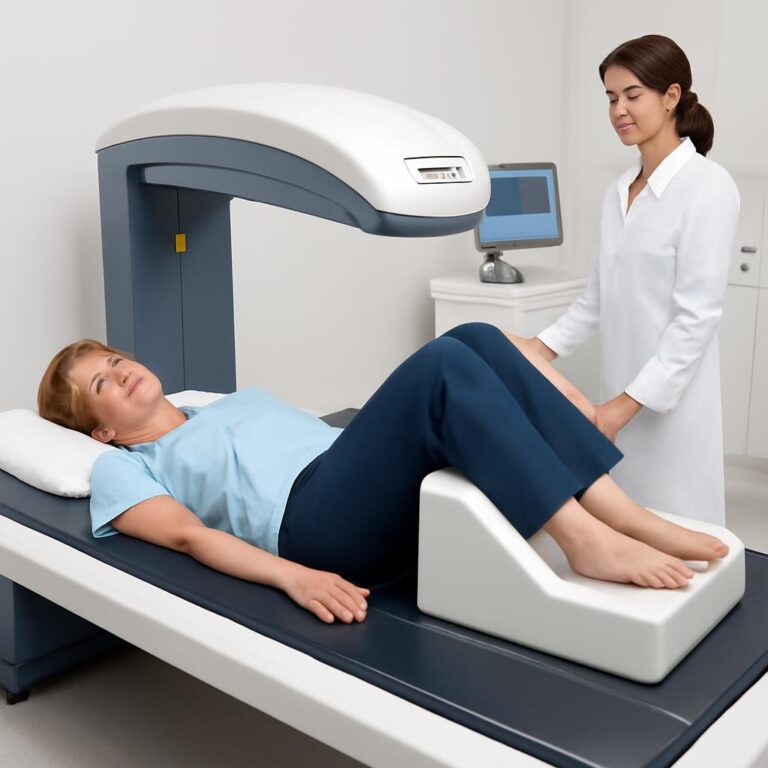
- A DXA scan. It is the only way to know where you stand and whether anything changed. See how often to scan and T-score vs Z-score.
- Your doctor. Fracture risk is individual, and many causes of bone loss are medical.
- Prescribed medicine. The NIAMS overview notes that taking prescribed medicines can help prevent fractures in people with osteoporosis. See medication vs natural approaches.
- Calcium and vitamin D basics. The same NIAMS overview recommends a diet rich in calcium and vitamin D. Our diet and exercise plan covers it.
- Strength training and weight-bearing exercise. Begin with resistance bands and hip exercises.
- Fall prevention. Most fractures follow falls. See home modifications to reduce fall risk.
See current price and refund terms →
Frequently asked questions
Osteoboost vs OsteoStrong: which is better?
Neither has been shown to reduce fractures, so there is no evidence-based “better”. Osteoboost has a sham-controlled trial and FDA authorisation for a specific group at a higher price; OsteoStrong is a weekly supervised service with mixed research. Your doctor can help choose.
Is Osteoboost cheaper than OsteoStrong?
It depends on how long you stay. Osteoboost is a one-time cost of about $995 at the time of writing; OsteoStrong is a recurring membership priced by each centre. Compare a written quote over your intended period.
Is The Bone Density Solution an alternative to Osteoboost?
No. One is a regulated device, the other is an information guide. They address different needs and neither replaces medical care. Some people may use a guide for diet and habits while discussing a device with their doctor.
Does The Bone Density Solution have clinical proof?
No clinical trial of the branded programme exists. It draws on general nutrition and exercise research of mixed quality. Treat it as a structured lifestyle guide, not a treatment, and talk to your doctor.
Can I use Osteoboost with osteoporosis medicine?
The trial excluded people taking bone-affecting medicines and the company does not address it in the pages we read. Ask your prescriber before combining anything, and never stop a medicine on your own.
Which is best for osteopenia?
Standard advice is a DXA-based plan from your doctor: calcium and vitamin D from food, regular strength and weight-bearing exercise, fall prevention and medicine where indicated. These products are optional extras, not substitutes.
Is there a cheaper way to load bones?
Yes, regular walking, resistance-band work and other weight-bearing exercise, cleared with your doctor. See our guide to improving bone health after 50.
Verdict
If you are a postmenopausal woman with osteopenia, want a device and can afford it, Osteoboost has the most formal evidence and regulatory status of the three, with the limits described above. If you want supervision and a routine, OsteoStrong may suit you, but check the contract and temper expectations about bone density. If you want an inexpensive, food-first plan to start with, The Bone Density Solution is our own suggestion, with the caveat that it is a guide and not a treatment. In every case, scan, talk to your doctor and keep the basics going. For a broader beginning point, read how to increase bone density after 50.
How we compared them
This comparison is based on the manufacturers’ published information, the published studies cited in our Osteoboost and OsteoStrong articles, our reading of the digital guide, and the NIAMS osteoporosis overview from the U.S. National Institutes of Health. We have not used Osteoboost or OsteoStrong. Last checked: October 2026. Spotted an error? Tell us via the contact page and we will check and fix it.
Sources and further reading
- Osteoboost sham-controlled trial, JBMR Plus 2024
- OsteoStrong scoping review, Osteoporosis International 2025
- BONEMORE randomised trial, Archives of Osteoporosis 2026
- NIAMS (NIH): Osteoporosis overview
Related reading on this site: Bones After 50 home · Editorial team · Medical disclaimer · Affiliate disclosure